Rattling Chains Photo of the Week: April 15

Photo by Jenny Cook

Jenny says:

Winter version of a pull cart – I call this: Brilliant! We are the pioneers of disc golf and with that comes something new to be seen at almost every tournament I attend.

From backpacks, to rain hoods, to “golden retrievers,” I feel the need to capture these innovations (big or small) and people that make them happen. He, along with about 30 other brave souls, made it out that day to the 2012 Ice Bowl at
Jericho Lake in Aurora, Il.

Techie info:

  • Camera: Canon EOS Rebel T1i
  • Shutter speed: 1/160
  • F-stop: F/11
  • ISO: 200

Why we chose to use this photo:

This is the way to play disc golf in the winter! Personally, I don’t dig flinging plastic when there’s snow on the ground. But when you decide to do so, why not do it in a way like this? Kudos to the person pulling the sled. Keep the bag as dry as possible and go do your thing.

Nice capture, Jenny!

NOTE: We’ve received some photos for the photo of the week contest, but there’s no information attached. We need info about the image to the best of your ability. Also, if you have a good shot — please send it in! We can’t continue these features without the help of disc golfers!

Have some great images you want to share with the Rattling Chains readers? Please e-mail pj [at] rattlingchains.com with the subject “Photo of the Week.” Please note that we can’t guarantee all images will be used. Send as many as you would like as if the photos are top notch, we’ll use more than one from you!

When sending in images, please remember to send the story about the photo, the location and any technical information possible! The story can be as long or as short as you like, but please make sure you give some details!

Don’t forget to follow us on Twitter and like us on Facebook!

The number-crunching approach to better disc golf scores

Today’s hopefully useful game improvement post touches on a way you can improve scores on the course by recording and mining the data of past rounds while off the course.

However, talking about crunching numbers tends to get dry in a hurry — especially if you’re reading this in a disc golf frame of mind. So we’ll ease into the meat of this lesson by way of an illustration. The guinea pig in this case is yours truly.

I shot an even-par 84 (28 holes) morning round at DeLaveaga last weekend, and earned satisfaction on two different counts.

First, with the exception of only a few holes, the course is set up in its toughest configuration in preparation of the fast-approaching Masters Cup — an annual stop on the PDGA National Tour. Par in that layout is good for a plus-1000 rated round, and right now, I’ll take that any day of the week and twice on tournament weekends.

Hole No. 1 at DeLaveaga. (Photo by John Hernlund)

The other reason why I was able to bask in my own pysche a little after my round today — and the main subject of this post — is that I had a game plan and executed it quite well. My strategy at DeLa, when the course is long, is to think par at nearly every hole, even off the tee, and even though I can birdie most of the holes with a perfect tee shot and good putt. The result in this case was 24 pars, two birdies, and two bogeys — one of which was on Hole 13, which plays more like a par 4.

So why play for par on a hole when I know I’m capable of doing better? Because being capable of a executing a shot once and being capable of executing it consistently are two very different things. Understanding that basic fact is the first step in properly assessing the risk/reward quotient of every shot in golf — disc or otherwise.

Continue reading

Destination Lancaster: A mini disc golf Mecca in Amish Country

Three of the original members of the MDGF — from left, Merrill Detweiler, Linc Morgan and Donnie Brooks, pose next to Brooks’ original prototype mini basket at his course near Lancaster, Pa.

By P.J. Harmer — Rattling Chains staff

Nestled within the beautiful surroundings of Amish Country in Lancaster, Pa., is a virtual disc golf paradise.

The paradise differs a bit, however, from what many might think about when it comes to a disc golf haven. This is on a smaller scale.

A much smaller scale.

In fact, you could call it a mini paradise.

It’s almost shocking to know what’s in this area — nearly a dozen mini disc golf courses. It’s the home of the Mini Disc Golf Federation, a tight-knit group that works to spread the word of mini disc golf — a sport like the “bigger” version with a few rule changes to help with the smaller scale of the game.

For many, the mini discs they see or use are for one thing — marking their lies during a round of big disc golf.

But these discs — many of them, anyway — can be thrown. Sometimes, quite a distance, too. It’s rumored some minis have been thrown upward of 400 feet.

Mini baskets and courses can be put in small areas, including residential areas — such as this basket at Starry Stompin’ Grounds outside of Lancaster.

A visit to the Lancaster County area can show you how creative and different mini disc golf is.

“Mini disc golf has more oohs, ahhs, and wows than big golf does,” said Linc Morgan, who owns a mini disc golf course in Lancaster. “It’s quicker, seems more relaxed, played in smaller places and it’s versatile.”

Morgan plays both mini and big disc golf — at high levels. The second member of the MDGF (.00002), Morgan is also an earlier member of the PDGA (7518) and is a pro  player with a 986 rating.

The MDGF

Created in 2004, the MDGF has slowly started to grow. There are nearly 100 members who have paid to become part of the group.

“We did it to grow the sport,” said Donnie Brooks, the original member of the MDGF and the head honcho for the group. “Basically to promote it and get more courses in.”

Continue reading

Cardio Disc Golf: A new fitness trend to sweep the nation?

Rattling Chains writer Steve Hill doing a new fitness trend -- Cardio Disc Golf! (photo by Kelly Hill)

Cue intimidating, yet cheesy sounding voice over…

Insanity. P90X. Boot camp. Today’s new, intense workout programs promise to “get you ripped” or give you a “beach body” in no time at all. But, do you know what none of these workouts do?

Get you outdoors.

This is why I am taking this opportunity to unveil the newest trend in extreme physical fitness: Cardio Disc Golf.

The premise is simple, really. Want to get a real workout while also enjoying your favorite sport? Just carry a driver and a putter (or any two discs of your choosing), and run or jog between shots. Work up a sweat, and get in a quick round. You’ll be ripped and ready for summer in no time.

OK, so this isn’t an actual workout program (yet), but after kicking the idea around with Rattling Chains head honcho P.J., we decided I should give it a whirl. We thought it might be fun to see how it would affect my game, and if I could burn a couple of extra calories in the process, then it would be a bonus.

Besides, it kind of merges the best of two worlds for me. Before I started playing disc golf, I was an avid runner, completing numerous half-marathons, and even a couple of rounds of 26.2 miles. Now, though, I don’t always have time to go for a run and play disc golf, so I usually have a dilemma.

Hill tees off on hole 8 at Ford Park in Redlands, Calif. (Photo by Kelly Hill)

And by dilemma, I mean I choose disc golf nine out of 10 times, then feel guilty about not running.

Cardio Disc Golf, then, would assuage any remorse I would feel about not running, plus bring me the pleasure of disc golf. It’s a win-win situation.

The more I thought about it, though, the more I realized that merely running between shots wasn’t enough, so I added a couple of additional stipulations to really take this workout to the next level.

Continue reading

Poll 6: Why do you play disc golf?

You disc golfers really do enjoy carrying plastic when you play some disc golf, eh?

Last week’s poll, “How many discs do you carry during a round?” really showed that golfers like having discs with them.

We had 468 voters cast a ballot in the latest poll and the winning selection — with 155 votes (33 percent) — was carrying 16-20 discs. In second — with 140 votes (30 percent) — was 11-15 discs.

That’s a lot of plastic!

To show more proof of that? Third place with 21 or more discs, which garnered 86 votes (18 percent). In fourth was 6-10 discs (71 votes/15 percent), followed by 2-5 discs (15 votes/3 percent) and one disc (1 vote).

The reasons for how many discs are carried differ — some carried more in tournaments, some in casual rounds (to test/break in discs). Some just carried a lot of discs. Other didn’t carry as many.

This is definitely a personal preference!

Reader Heymo says carrying 10 discs is all that can fit in the bag for now.

I’m trying to keep my bag simple and learn how certain discs fly first. … Once I have the feeling that I actually know what I’m doing with those discs I will probably branch out, but this might be a while.

Continue reading

Weekly disc golf wrap: News and notes

It seemed somewhat quiet in the world of disc golf this week, at least in regard to traditional media.

Maybe it’s because the eyes of the golf world are watching that other type of golf in Augusta?

Nah!

There were some interesting news items this week, however, so allow us to share them with you! Check ’em out for some good reading!

And for those who celebrate it, Happy Easter!

April 7

April 6

  • Hidden Sarasota: Park transformed by disc golf (Sarasota, Fla.)

April 5

April 4

April 3

  • New Saginaw Township disc golf course adds to sport’s growing popularity (Saginaw Township, Mich.)

If you have any comments, questions, thoughts, ideas or anything else, feel free to e-mail me and the crew at: pj [at] rattlingchains.com. Don’t forget to follow us on Twitter and like us on Facebook!

April 7: What’s in your bag?

Aaron Cronk's bag -- A Fade Crunch

This week’s What’s in your bag? feature shows us the contents of Aaron Cronk, who starts with his banana-colored Fade Crunch and builds from there.

Cronk, of Lutz, Fla., calls USF Riverfront (Tampa) his home course.

Now let’s take a peek at his bag contents…

He’s been playing for about a year. Discs 1-11 are drivers, 12 and 13 are mid-ranges, and 14 and 15 are my putters.

1. Innova Katana (Star): This is my top distance driver. I get more distance and more speed out of this than my other discs. This has also become my favorite roller disc for big distance.

2. Innova Wraith (Echo Star): Great for distance and skip shots. The wraith was the second driver I ever owned.

3. DKG Tempest (Cu plastic): All DKG discs float in water. When I started using this disc, I was landing closer to the basket than I had before. These discs beat in pretty good and this has become one of my most flippy distance drivers

4. Innova Wahoo (R-Pro): Floats in water. This is an older disc that has been beaten in pretty good. It flips over real easy so if I throw it flat, it’ll go right. This is also one of my roller discs.

All that plastic...

5. Innova Archon (Champion): This disc flies straight for me. If I put some anhyzer on it, it will fade back and land flat.

6. Innova Sidewinder (DX): This disc is beaten in to the point where if it’s thrown flat, it’ll fly to the right with little fade at the end. This is another one of my roller discs. When I want to throw a roller with less distance than my Katana, I’ll use this.

7. Innova Roadrunner (Champion): This is relatively new to my bag. I got it from the Tour del Sol Triple Crown Series at Pine Oaks in Ocala, Florida. I’ve used it for straight shots so far. Roadrunners are supposed to be great roller discs, but I still need to test it out.

8. Innova Viking (Champion): The viking was the first disc I ever owned so it holds a special place in my bag. Needless to say, this is also one of my top discs. The Viking holds a great line with a nice fade at the end. It’s a slower driver so I use it when I need less distance.

9. Innova Viking (DX): This is another disc that is beaten in. When I need more high speed turn than my champion Viking, I’ll throw this flat and it will turn right for me.

10. Innova FL (Pro): This a Pro Plastic Firebird with less fade at the end. I like to use this mainly for tomahawk throws to get out of trouble.

11. Innova TL (Champion): Basically a TeeBird with less fade at the end. This feels better in my hand than a TeeBird, and I use it for straight shots.

12. MVP Axis (Proton): This is my straight flying mid-range. It’s similar to a Buzzz SS but seems to get a bit more glide on it. This is also good for turnover shots.

13. Discraft Zone (Pro D): I use this for an over-stable mid-range. It’s great in the wind. I like the Zone for short skip shots and flex shots.

14. Gateway Wizard (Super Stupid Soft): This is my back up putter if my putts are a bit off. I also use this for windier conditions. I like my putters to be on the heavier side and this is 175g.

15. Gateway Voodoo (Super Stupid Soft): This is my main putter. Out of all the putters I’ve tried, this feels the most comfortable. This weighs 174g.

Also in the bag…

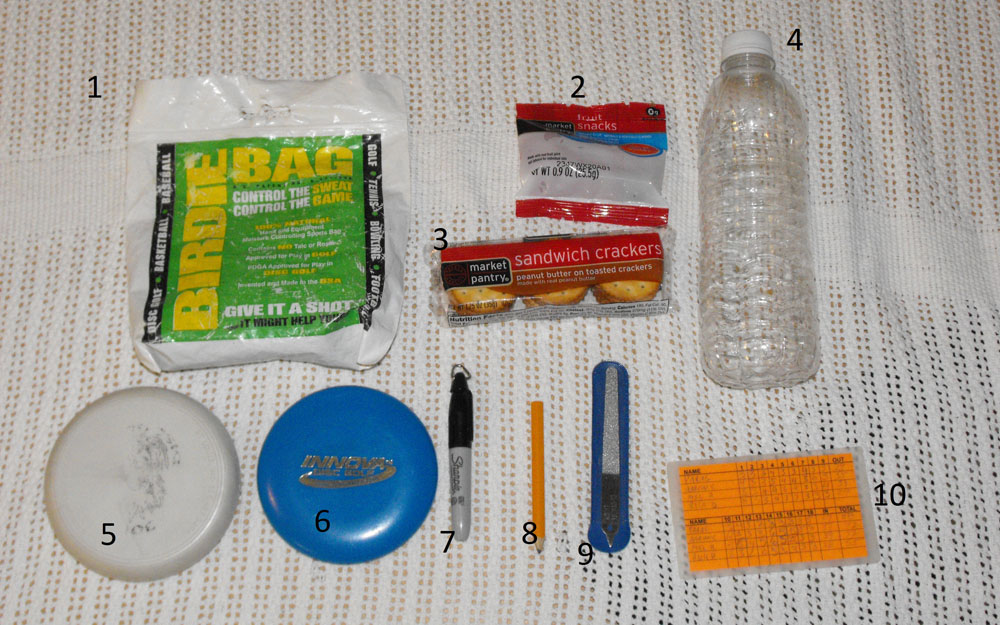
1. Birdie Bag: Everyone should get one of these. Florida gets pretty humid and muggy so when my hands get sweaty, I bust this out.

2-3. Fruit snacks and peanut butter sandwich crackers: If I’m going to play more than one round, I like to throw snacks in my bag.

4. Water bottle: I always carry water with me no matter how short of a time I’m going to play

Other goodies...

5. Gateway Dual Stash Mini: This is my main mini. It’s great to keep extra cash in it for handicap or to pay the occasional squid.

6. Innova Mini: This is my back up mini that I hope to never use (don’t want to lose that cash). It’s great to have in case a friend needs to borrow a mini though.

7. Sharpie Mini Marker: Fits in my bag better than a normal sized marker. You never know when you’ll buy a new disc or get that ace.

8. Pencil: just a standard golf pencil. I also carry a mechanical pencil as a backup.

9. Nail File: Sometimes I forget to cut my nails before I play. I used to carry clippers, but I would cut my nails too short and end up bleeding. If anyone had this happen to them, get a nail file.

10. Marshall Street Reusable Scorecard: Even though I use my cell phone and Easy ScoreCard Pro to record my rounds, this is a great backup. The cards are erasable so they’re great for handicap rounds. Also these are waterproof so they can handle bad weather.

That’s what’s in Aaron Cronk’s bag.

What’s in yours?

Want to submit your bag and contents? Here’s what we need: A couple of photos of your bag and discs. Put together a list of everything you carry in the bag — from food to discs to anything else. Then maybe give a paragraph or two about your bag and if there’s anything you do between casual and tournament rounds etc. Finally, don’t forget your name, location and home course! Cell phone photos are fine, but please try and make it as high quality as possible. Grainy shots might not be able to be used. E-mail all of these things to pj [at] rattlingchains.com with the subject “What’s in my bag.”

Rattling Chains with Avery Jenkins: Getting aggressive at the Memorial

With my first PDGA-sanctioned tournament of the year behind me, it was time to leave Las Vegas behind and make the six-hour ride to Phoenix, Ariz..

Nate Doss, Val Jenkins and I set out early in the morning to travel the six hours to Phoenix, Ariz., for the Memorial Championship, an event on the National Tour. In the back of the Sprinter Van, I took naps and watched movies. That’s how you travel!

The Memorial is a four-round, four-day event, beginning on Wednesday and ending on Saturday. That gives players two days to practice. It really only gives one day to practice if you stay the night in Vegas and use Monday as a travel day.

Arriving at Fountain Hills at about 4:30 p.m., we met with Discmania stars Jussi Meresmaa and Seppo Paju. I looked forward to rooming with them for the rest of the week.

The Holiday Inn were stayed at was conveniently located across the street from the course. It’s one of the main reasons we have stayed here the past two years. That means we only have to travel to the Vista Del Camino course twice and the other days we just have to walk across the street. We were less than 400 feet from the basket on hole 15. The final round and awards were also held at this course.

I grabbed my bag as Val, Nate, Seppo and I headed out for a quick practice round in limited daylight. It was less than two hours until sundown. This is a course I have played for the past 10-plus years. They have altered some of the holes throughout the years, but it’s basically the same layout that we play each year.

With winds gusting at more than 35 mph, it made for an interesting round. We avoided many of the approach shots to the baskets near the water as it wasn’t worth it to lose a good upshot disc a few days before the event. I still ended up losing a Star Teebird and a Power Driver 2 on hole 17, which is one of the longer downhill holes. The wind came from the right and carried them left and sent them into the water. I didn’t want to lose those crucial discs before the tournament, but I always carry backups for each of my go-to discs.

Avery Jenkins putts during the Memorial Championship. (Photo courtesy Marble Jones: http://www.marblejones.com)

The Fountain Hills course is gorgeous and it’s in my top-10 list for courses. It has a great layout with rolling hills surrounding a lake. In the center of the lake is a huge water fountain. It’s the fourth-tallest fountain in the world. It can reach heights of 560 feet, which it does on select holidays and celebrations.

The course is challenging because there’s a chance to throw out-of-bounds in the water on nearly every hole. It’s especially difficult when the winds are ripping. On the other hand, nearly every hole is reachable in one shot, so when the wind is down, the scores can go really low on this par-56 course.

Continue reading

Creative Corner: Need a bag for your minis?

Darren reverted back to his home ec classes to make a bag for mini disc golf.

As a disc golfer, I have slowly developed my skills by playing on a regular basis and learning all the discs in my bag and how they fly.

Nobody told me I’d have to do the same thing with minis.

Minis?

As if it wasn’t enough to play disc golf with regular discs, now I have to learn how to throw my mini?

These shorts made for good fabric to make a mini bag with.

I was recently invited to play some mini disc courses in Pennsylvania. After doing some YouTube research, I found some short movies on how to throw a mini. I also received some helpful advice from New Jersey-based professional Bob Graham.

Add those things together and I was able to throw the minis exceptionally far.

As a bit of a disc junkie, I have accumulated quite a few different minis. And they all seemed to do different things, so I got wondering — are there mini bags? I searched the internet and found some bags for minis, but most of them were plain and simple.

Continue reading

To save strokes near the basket, think more like a golfer

Disc golf and ball golf can both reduce a grown man to tears, and they can both elicit language from a grown woman that would make a Marine drill sergeant blush. Is it because we, the loyal devotees of our sport, are mostly unstable people drawn to these tests of sanity like moths to a bug zapper?

BZZZT!

Well, maybe. But I have another theory.

Sure, bad breaks happen with heartbreaking and hair-pulling randomness — like my recent 40-foot putt for birdie that hit the cage 1/2 inch short of paydirt, then rolled down the sloped green and across an OB line 60 feet away (result: double bogey). Why?

No, really. WHY?!

But that kind of frustration dissipates quicker than the other kind. I’m referring to that instinctive knowledge, after a round, or a hole, or a throw, that we could have done better. Specifically, that we would have done better if not for some type of mental error. That kind can keep you tossing and turning at night.

Maybe it was a poor decision. Or the fact that it became quite obvious — a fraction of a second after the disc was released — that the wrong thought dominated the wrong lobe at the wrong time. Whatever. I’m convinced, though, that the mental side of golf is at the root of the love/hate paradox that keeps most avid players coming back again and again.

You see, even those of us with the most marginal physical skills know that if we can only squeeze all the potential out of those skills by playing smarter, our scores will improve immediately. As you read my posts here on Rattling Chains, you’ll discover this is a favorite theme of mine. We can all improve simply by playing smarter, and there are many, many, many ways to do that.

Saving strokes on the green

And what better place to start than on the green, around the basket? Mistakes related to putting are the quickest way to take needless strokes (from birdie to bogey, just like that!) so it stands to reason that plugging leaks in one’s putting game immediately translates to lower average scores.

Continue reading