Duo goes underground to celebrate a grand milestone

Matt Sime and Dan Kilgore at Crystal City Underground. (contributed photo)

By P.J. Harmer — Rattling Chains staff

In the big scheme of life, three years can be a long time.

Over the course of three years, people can accomplish many things. You can get a college degree in three years, if you work hard enough. Three years is the difference between those graduating high school at age 18 and being able to legally drink.

Three years is 1,095 days — or 1,096 if there’s a leap year in that stretch.

For Matt Sime, three years means so much more.

Sime, who claims Alden, Minn., — or his van — as his home, has been playing disc golf for three years. In that three years, he’s really explored disc golf courses around the country. Exploring courses is something most disc golfers can probably claim to have done during their first three years in the game.

But can they claim 1,000 courses played?

Yes, you read that number correctly. On Sept. 31, Sime played his 1,000th course in his third year of playing disc golf — an amazing number to be sure.

He wasn’t the only one celebrating that milestone though — Dan Kilgore teamed up and played his 1,000th course at the same time, albeit taking a bit longer to reach the milestone.

To be fair, Sime got his first glimpse of the sport in 2004 at Vermilion Community College (Ely, Minn.) in 2004. But he said he only played the course once and there was no follow up. Then in 2009, sometime about Easter, he was on a rock-climbing trip at Horseshoe Canyon Ranch (Arkansas). He said he caught a glimpse of how great the game could be. With rental discs and course fees included, he said he played at least three rounds that weekend.

Again, a break followed, but much shorter this time. It was Thanksgiving 2009 when he got his first taste of hitting a bunch of courses. He was on another rock-climbing trip with the same group of friends and they decided to buy a disc and check out the local courses near Las Vegas, Nevada.

“From there, one disc led to five, led to 100,” Sime said. “Five courses led to 100, led to, well you know the rest of the story.”

He played 998 of the courses in fewer than three years. The other two were the original ones.
Continue reading

A beginner’s guide to dyeing discs

By Kevin Morrow — For Rattling Chains

In my original post about dyeing discs on Rattling Chains, I wrote about how I got into dyeing discs and gave some other thoughts on the process.

I’ve been dyeing discs for a couple of months and have received a lot of feedback on how good the discs look. I’ve also had people who are interested in doing it ask a lot of questions about the process.

I’m going to explain my process with a step-by-step look.

First, you need some specific tools to make it easier.

A light source, such as a light table, and an Xacto knife with No. 10 blades are needed. I use a new blade for each mask I cut. (Sometimes, however, I will use the same blade for multiple small designs).

My light source is something I have left over from my pre-digital photography days — a Logan desktop light box I used to edit negatives. You might be able to find these pretty cheap as most photographers who went digital could have them sitting in a closet collecting dust.

Another way to get a light source is if you have a glass table, put a lamp under it.

Other items needed include a black Sharpie marker, a roll of simple masking tape and an old credit card.

For supplies, I use Orcal 651 clear vinyl, which I get from U.S. Cutter. I use the clear vinyl because it’s easier for me to see through. I also use iPoly Dyes (iDye for polyester fabrics), which I get from Dharma Trading. I don’t use Rit dyes because they changed the formula, meaning one has to find certain lot numbers and that can be a hassle.

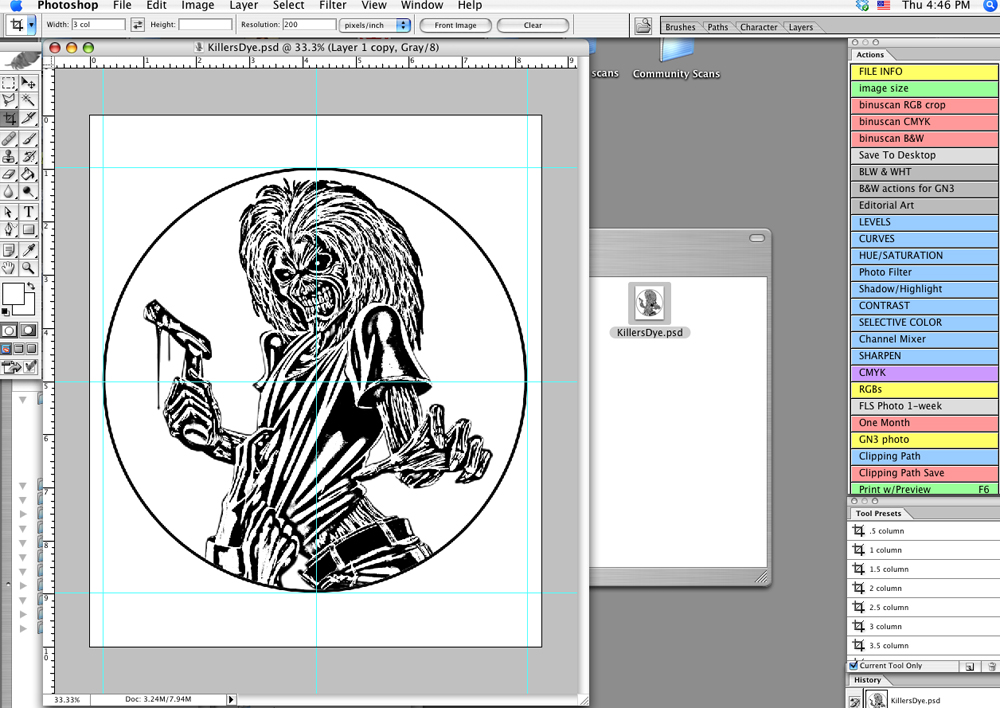
I do my design work with Photoshop.

With everything you need in hand, it’s time to get your art ready. I do all my designs in Adobe Photoshop. But use whatever art program you are most comfortable with.

I have a base file that is an 8-inch circle because most discs are about 8.5 inches in diameter. I started with a full color album and worked it to black-and-white line art. Once you get it the way you want, print it out and tape it to the backside of a square of the vinyl.

Then cut the vinyl at least an inch larger than the print on each side. I usually like to have about two inches extended from the edge.

Continue reading

Signage can go a long way in making a course top-notch

It doesn’t matter what kind of sign it is — as long as there are signs to help people navigate their way around courses. (photo by Jenny Cook)

By Jenny Cook — Rattling Chains staff

Navigation issues on the disc golf course: How would you rate your home course?

Navigating a disc golf should not be difficult.

I once drove 400 miles eager to play legitimate par 4s and hole-shaping shots to test my game. After the first few holes at this course, my mood suddenly changed when I began struggling to navigate my way around the course.

If the obvious natural paths cutting through the trees and worn-down grass past the basket take me where I need to go next, then I’m a happy camper and no signage is needed.

Signs attached to the bottom of baskets can be extremely helpful. (photo by Jenny Cook)

For times when I look past the basket to five different and equally worn-down trails, with no indication of which one to take, I’ll use common sense of course flow to make my decision.

But I don’t always get it right on the first try, which means I’m obligated to try each one until I find the next hole. One or two holes of this out of 18 is not a bad ratio. It’s when the number of times I experience this increases throughout my round that I become frustrated — especially if the paths lead you to several different unmarked holes.

Now it’s time for technology — if you have a phone signal, that is. I pull up DGCoursereview.com on my phone to compare the hole I thought I should be on to the photos on the website.

Continue reading

Photo focus: Oct. 23

(Photo focus will run every two weeks or so on Rattling Chains. The idea is to focus on disc golf photographs submitted by staff members and readers. To see the guidelines for submitting a photograph for this feature, click here.)

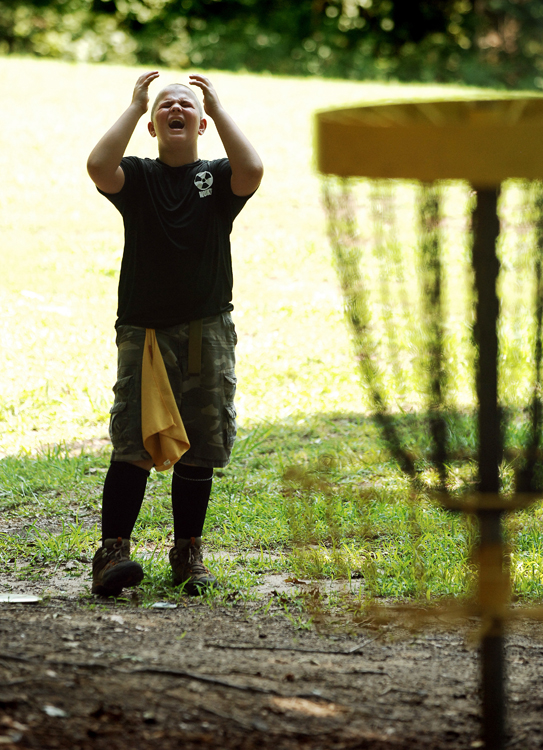
Raw emotion at PDGA Worlds. (Photo by Kevin Morrow)

The story: As a sports photographer, your skill set is very refined. It’s nothing like art, feature or scenic photography. I tend to call it dog photography. You wait around for something to happen in front of you.

The key is understanding sports and being able to put yourself in the right spot and be ready when the event happens in front of you. Whether is professional football, NASCAR, baseball or even high school sports, understanding the game is critical to be able to put yourself in that position to succeed.

Disc golf presents unique issues similar to ball golf, but a bit tougher — the fight between wanting to get the best possible imaging without bothering the golfer.

Getting good images of disc golfers putting is a real trick. You make your way to a basket and scan on the discs around the ground then figure out the best position to get as many players putting as possible. Once you pick your spot, you can’t move and most group fairly quickly. That means it’s over before you can move, anyway. So, if you pick the wrong spot, you’ve wasted that opportunity.

Continue reading

Poll 31: Do you make the putt?

I know not everybody is into the pro tour. And, as the sport is continually growing, that is understandable with coverage just starting to expand as well.

This past weekend was the Players Cup, a match-play style championship. On the line was more than $20,000 in prizes for the men and $2,000 for a smaller women’s field.

That got me thinking about the way these guys play.

No matter the sport, being at the professional level goes beyond skill. It’s also mental. You have to constantly be thinking about shot selection, disc selection, your score, what you might have to do etc.

And you have to remain calm!

Let’s also remember that disc golfers aren’t paid the highest in the world. They often travel together in cars or vans from tournament to tournament, sometimes competing for small purses. The National Tour events, majors and events such as the Players Cup give the players a chance for bigger paydays.

So below, after we check in with last week’s poll, I’m going to put you in their shoes. Check out the situation. It’s a yes or no question. But I really want to see some comments and see why people chose what they did.

But first, let’s take a quick look at last week’s poll.

Continue reading

October Madness arrives as the Players Cup begins

Dave Feldberg is the overall top seed for the Players Cup, which is running this weekend in Texas.

By P.J. Harmer — Rattling Chains staff

As disc golf continues to grow and evolve, different formats of tournaments, leagues and other aspects of the game will likely be tried to see what works.

Traditionally, tournaments are usually played in a normal setting — stroke play and in divisions. Occasionally, you’ll get a doubles tournament or some sort of non-traditional format, such as best-throw or alternate shot.

On a higher level, though, it pretty much remains the same across the board — stroke play over a certain number of rounds.

Insert the Players Cup, a three-day match-play format tournament featuring 64 of the top disc golfers in the world.

Vibram is the top sponsor of the Players Cup, which is scheduled to run Friday through Sunday at Twin Parks Country Club in Dripping Springs, Texas, which is about 10 minutes outside of Austin.

“I have always wanted to create a true disc golf spectacle,” said Steve Dodge, Vibram Disc Golf’s product manager. “Something that is compelling to watch and will get the average disc golfer excited to be a part of. A bracketed match-play tournament, like the NCAA March Madness, was exactly what I was looking for.”

Enter October Madness.

Originally founded in 2005 by Mike Barnett of Sun King Discs, the Players Cup served as an end-of-season celebration with players who had won events during the year. When the event took a hiatus in 2008, Dodge took that opportunity to discuss with Barnett the idea of making it into a match-play championship.

This tournament marks the third year of the setup.

“In the first two years, we have created an online bracket that people fill out and win prizes,” Dodge said. “The goal of the Players Cup is to celebrate the growth of our sport, create a spectacle and generate interest in watching the best disc golfers in the world.”

Continue reading

Finding magic at leagues

By Aaron Minton — For Rattling Chains

“Eight of Spades!” I called out.

“Who has the Eight?” As I searched around for the guy with the eight card, (my 5-foot, 7-inch stature was  not helping at all) I hoped that my new partner, and single-serving friend, would be just below my ability level.

This last summer has been one ruled by disc golf.

As a teacher, this is a good thing. Keeping me busy between Breaking Bad episodes on Netflix and reading super nerdy history books, disc golf kept me busy and in shape. This day was different as I finally got the gumption to attend leagues this summer. I spent 100 dollars on a membership back in December at my favorite course and was ready to test my skills with my non-regular disc golf friends.

The cost is $6 for members — the usual greens fee (or, should I say, tree fee?) for non-members. Five goes to the payout and one goes to the ace pot.

Back to the cards.

“Hi, I am Aaron.”

“Mike”

Mike was a tall fellow, young and unassuming. I had never seen Mike around before and was continuing in my hope that that he would be right around my level, you know, shooting about 5-over-par on average.

Mike and I were the black eights. We drew the cards at random, and were paired with the red eights. And yes we started at the eighth hole. The logic followed as the 50 or so disc golfers meandered their way to their card-directed tees. It was me and Mike, best disc, against the world.

Continue reading

Words with Wysocki: Exploring Philly and winning the Yetter

There are times when you leave one tournament and don’t know what’s next. Though I wanted to play the Eric C. Yetter Tournament, I wasn’t entered. So, I thought I was going to be heading home.

Then I got a call from Darren Dolezel, who told me I could have his spot. He called the tournament director to tell him he’d give up his spot for me, which was awesome. But the TD didn’t go for it, saying it wasn’t fair for all the others on the waitlist, which is understandable.

I looked at the waitlist to see if it was worth going to the tournament or if I had a chance to get in. I noticed my name wasn’t as high on the list as I thought. It turned out the TD had forgotten to put me on the waitlist because of a miscommunication. He squared that up and I ended up getting in.

After all that, I headed out to Philadelphia for the Yetter, which I was pumped for because I like the tournament and the course. I played in it the year before and placed third. I was looking to improve on that.

In Philadelphia, I stayed with my buddy Dan Meers, who lives downtown. He was an awesome host. We got to see the Rocky statue and we also ate a famous Philly cheesesteak at a place called Gooey Looie’s. It was one of the best cheesesteaks I’ve ever had. It was 20 ounces of steak — so one of the biggest I’ve ever had!

The guy working at Gooey Looie’s told me the Food Network was coming the next day to film. That’s how you know you picked a special place.

Continue reading

Company Closeup: Skulboy Designs

A Skulboy design.

By Steve Hill — Rattling Chains staff

Thinking back to the days of middle school and high school, most people can probably recall that one artistic kid who would doodle on people’s binders and scrawl intricate scenes for the most mundane of assignments.

Duncan Crawford was that kid.

“I’m the guy that people remember as the one drawing on everybody’s notebooks,” said Crawford, the mind behind Skulboy Designs. “I’ve gone barbarians and superheroes pretty much since I was a kid.”

Duncan Crawford at work on a design.

As an adult, Crawford has taken his art from the notebooks to the disc golf course, as he pens unique, skull-filled custom stamps under the moniker Skulboy Designs. Known for aggressive, hand-drawn renditions of skeletons, skulls, and images both mythical and historical, Crawford has gained a following among disc golfers looking for more than the traditional stamp on their plastic.

And while his designs have developed a following, their gestation was born out of simply wanting something interesting for himself.

“Once I started collecting discs and getting discs, I found that there were not enough skulls on discs,” he said. “I’ve always been a skull guy. I love skulls, and there just weren’t enough, you know?”

Based in Monrovia, California, Crawford is surrounded by a bevy of courses and an established disc golf scene, which is where he found his path to stamp design. Playing many rounds at Sylmar Veterans Park – home of Steve and Bamba Rico of Legacy Discs – helped Crawford jump into the process by designing a custom stamp for the course’s 2010 Summertime Open.

The disc design that helped get it all going.

Crawford’s relationship with Bamba Rico was what really got the business off the ground.

“I did a stamp for him, then I started doing t-shirt designs for him,” Crawford said. “And that’s what got it all started.”

But when Crawford began to explore the idea of putting more of his designs on discs to sell on his own, he found the bulk orders that Innova and other manufacturers required to be cost prohibitive.

But a chance opportunity soon came his way — in the form of missing out on a tournament — as he was able to meet Dan Mangone, the owner of Discovering the World, a disc golf shop that happens to be the main West Coast distributor for Latitude 64 golf discs.

Continue reading

Poll 30: Time at the course

I know some people out there live at a disc golf course. And I say that figuratively and, well, literally for some.

But there are some of us who just can’t do it — despite maybe wanting to.

That will be the topic of this week’s poll and we’ll get to that shortly.

Until then, let’s kick back and check out last week’s poll.

Not many people voted last week — a whopping 66. Maybe that’s why people aren’t watching the game? They are out playing!

We asked you how many events you watch per year as a spectator. I didn’t see any this year and I was disappointed to miss the Vibram Open as it’s quite the event. Alas, this might be something that needs to be worked on as a game. If people think the game is going to expand a lot without people watching, it just won’t happen.

To be fair, some may be very happy with how the game is right now — and that’s perfectly fine, too.

So how did the readers vote? Twenty-six (39 percent) of voters said they don’t spectate at any events. That was followed by 1-2 (25 votes/38 percent), 3-5 (11 votes/17 percent), and a tie between 6-10 and more than 10, which drew two votes (3 percent) each.

Maybe down the line we’ll try and figure out why the numbers are this way. Until then, however, let’s see what some readers had to say.

Continue reading