Commentary: Get courses looking good to make them last

Working on a fresh piece of land is like having a blank canvas, which makes disc golf course design an art.

jenny_cookAs a result, when designers and contributors take the time for the careful design and implementation of the course and any type of course modifications — big or small — players get an unforgettable experience.

In the current world of disc golf course design, there are several aspects of design that can greatly increase the reputation of a course. There are many courses around the world that have made adjustments to their aesthetics, which increase the playing experience. For example, a hanging basket at the edge of a riverbank or a well-placed rock formation along a walkway to the next hole can make memories. General upkeep and monthly maintenance quickly increases the novelty.

Standout courses

Milo McIver State Park in Estacada, Oregon, is home to one of the best courses I have ever had the opportunity to play. I speak of this course from my experience of having played the original layout as well as the tournament layout (two courses) for the Beaver State Fling. From wide fairways and fir trees
that dwarf the baskets and people who play among them to nicely grooved tee pads and the overall scenery, this course is a must for your bucket list. The result of such attention to detail and thought is a disc golf course to which very few in the country can even compare.

Continue reading

Photo Focus: April 23

(Photo focus will run every week or two or so on Rattling Chains. The idea is to focus on disc golf photographs submitted by staff members and readers. To see the guidelines for submitting a photograph for this feature, click here.)

Cap (photo by Kevin King)

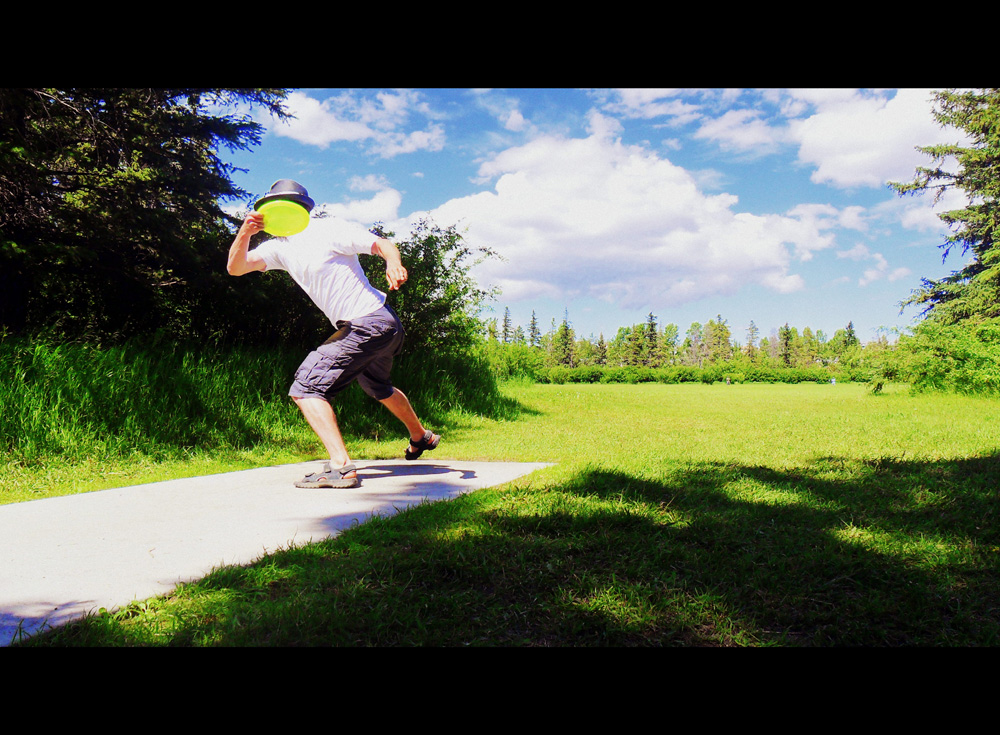
John Barnes throws during a long-distance competition. (photo by Kevin King)

I played in a tournament last June, along with a bunch of friends. We took part in the festivities, which included a long-drive competition. I thought I’d try to take some shots of the guys as they unloaded.

I personally like taking shots from low angles because it makes the subject seem a little more imposing.

John Barnes went up for one of his drives and I captured the moment at the exact time when the disc eclipsed his face. I thought it was a cool effect. If you look close enough, you can see the spotters out in the field.

This shot was taken at Baker Park in Calgary, Alberta, Canada. It’s the 17th tee and we were throwing into the field.

— Kevin King

Techie info:

  • Camera: Samsung ES73
  • Aperture: ƒ/3.5
  • Exposure: 1/750
  • Focal Length: 4.9 mm
  • ISO: 100

If you have any comments, questions, thoughts, ideas or anything else, feel free to e-mail me and the crew at: pj@rattlingchains.com. Don’t forget to follow us on Twitter and like us on Facebook!

Poll 55: Ranking where disc golf is in your world

As spring continues to grow in many parts of the disc golf universe (though we realize Mother Nature has decided to keep her snow season in parts of the United States and elsewhere), the sport becomes bigger in many people’s lives.

For those who skip playing in the winter or snow, this is probably the time of year where the itch to get out on the course is really big.

weekly_poll

So we’re going to find out where disc golf ranks in your life.

But, first, we want to go back to last week’s poll and check out the results and see what some readers had to say.

Last week, we wanted to know where you thought your game stood. Were you still improving and getting better? Maybe you’ve already peaked? Or, maybe your on the way down?

It was a poll we hoped would bring out some good thoughts, comments and explanations. But one thing is for sure — not many people think they are at the top of the mountain yet. And that’s a good thing.

Of the 116 people who voted in our poll, 93 percent (108 votes) said they were still getting better, followed by on my way down the hill, which gathered 4 percent of the vote (5 votes). Finally, 3 percent (3 votes) said they were at their peak.

We appreciate the honesty, that’s for sure.

Continue reading

Book Excerpt 4: The environmental impact of disc golf vs. ball golf

Followers of this blog know I’ve been working on a book project where my productivity has been on-and-off, depending on the demands of my day job. I’ve posted a few excerpts here in the past, all of which were pulled from the initial chapter, which sets the theme for the entire book.

It’s my assertion that golf is a wonderful game with numerous benefits, but the traditional version with clubs and balls is fraught with significant barriers (such as the cost and time required, which have been covered here in previous excerpts).

jack

The goal of the book is to broadly publicize the sport of disc golf to the masses, and in such a way that its true properties rather than the tired stereotypes or over-simplifications are understood. I share the conviction with many others that once this happens, participation in disc golf as a recreational activity will explode. Interest in professional disc golf as a form of spectator entertainment may follow but, frankly, that is not where my passion lies.

This excerpt is a discussion about the contrast between what many consider to be the unacceptable environmental impact of ball golf course development and maintenance and the relatively invisible footprint of disc golf courses, which are nearly always adapted to existing natural surroundings or already developed suburban parks.

For a specific example, consider the resources consumed in placing a ball golf course (many believe the just water required to keep the grass green is an unconscionable waste) in the middle of a desert wasteland. A disc golf course on the same piece of land, on the other hand, would involve nothing except strategically placed targets and tees. Virtually no manipulation of the landscape whatsoever.

I hope you enjoy the read, follow the links and share your thoughts with us.

Continue reading

A one-time plea for a good cause — and have a chance to win!

I won’t utilize this space too often for personal things, but this is one I am passionate about and it gives our readers a chance to win some pretty cool things.

Let me give a bit of a back story, however.

harmer_sigOn August 17, 2007, my father lost his battle with lung cancer. It was a painful time in my life and for those of you who have lost loved ones, I’m sure you can relate. Not a day goes by where I don’t miss him or think about him. It was the second time he battled cancer and he just didn’t have it in him to beat it a second time.

Since then, I’ve been highly involved in our local Relay for Life.

Each year we have a small team (usually fewer than 10 people) who do our best to raise money for the cause. We usually manage to have upward of $2,000 raised for our team, which is solid for a small group. Some bigger teams don’t get to that level.

I’d like to keep up that trend.

Besides hoping the disc golf community may be interested in helping, I also want to make sure I maximize the people having the chance to win these items. I’ve even thrown in a bit more — just for the Rattling Chains readers.

Continue reading

Poll 54: Your game and where you’re at with it

Let’s realize something when it comes to sports — and it can be a hard truth to accept.

Sometimes, you reach a point where you will not get too much better — the peak. Whether it’s because of age, talent, physical ability or whatever else, sometimes you just get to a point and that’s it.

weekly_pollThere’s a reason we have professionals and amateurs in sports.

If everyone could get to a certain level, there would be many more millionaires in our society. How many of you dreamed of being a professional baseball, football or basketball player at some point of your childhood?

Odds are quite a few.

Alas, reality set in. Now we do whatever we do to get by in this world and disc golf is part of that.

Disc golf is no different than any other sport in the regard of peaking.

But we’ll touch on the rest of this poll below. First, let’s head back to last week’s poll and get some results and see what some people had to say.

We asked you if regulars at your course present a good image of disc golf to newbies and other park users. The high majority of the votes pointed to yes with 73 (70 percent) of the 104 voters saying yes. However, 31 (30 percent) of the vote went to no, which isn’t a good thing, folks.

Continue reading

Building your better bag: A do-it-yourself guide

By Matthew Bertram — For Rattling Chains

In disc golf’s infancy, simplicity reigned supreme. You took your one disc, carried it in your hand, and played your round.

With the evolution of the game, though, has come a plethora of discs to cater your game to a tee — meaning that, more often than not, two hands aren’t even enough to carry everything.

Here is a Cabela’s bag built with a frame that lifts the discs up into a top-load orientation, allowing the bottom compartment to be used for storage. (photo by Matthew Bertram)

What once was an Under Armour backpack is now a disc golf bag, thanks to some intrepid DIY spirit.  (photo by Matthew Bertram)

Now, disc golf bags are undergoing a similar evolution, moving away from the standard bag-plus-quad straps to more backpack-style bags being available on the marketplace. Players, it seems, are starting to re-think how they carry their gear.

Backpacks are designed to offer better weight distribution by keeping the bulk of your disc weight high and tight to the body. Aside from the comfort aspect, they also tend to offer superior storage capacity. Whether the backpack is best for you is a personal decision, but what you can’t argue is the price — manufacturers of backpack bags demand a premium for the comfort and style they offer. Today, the industry standard for these bags is right around $200.00, and can climb near $300.00.

With the backpack market continuing to grow in 2013, more options will be available to disc golfers. If dropping $200.00 on a bag is of no concern to you, or if you find a backpack that gives you everything you’ve been looking for, then you’re making the right choice. These bags are designed for disc golfers by disc golfers. That fact should not be understated.

However, if you’d rather spend more money on discs or tournament entry fees, there is another path you might take – the do-it-yourself route.

The DIY contingent was once just as niche as the ones who carried true disc golf backpacks. But, as the backpack market grows, so do the amount of players who want more fiscally viable options – myself included. I’ve been tinkering and converting non-DG bags for a couple years now, and what I enjoy is being able to build something that is unique and functional out of a bag that had an entirely different purpose to begin with. My hope is that this article can offer some tips and tricks that I’ve learned (mostly by wasting money), so that you may be able to avoid the pitfalls and reap the benefits of creating your own disc golf backpack.

Continue reading

Product Review: Flywood Walking Stick

By P.J. Harmer, Steve Hill and Jack Trageser — Rattling Chains staff

Nature is something most disc golfers can relate with.

And it’s probably safe to say most disc golfers have had a close-up and intimate relationship with trees at some point during their playing days.

But it’s not too often when one gets to throw a tree. That’s what you get when you throw a Flywood disc.

flywood_1

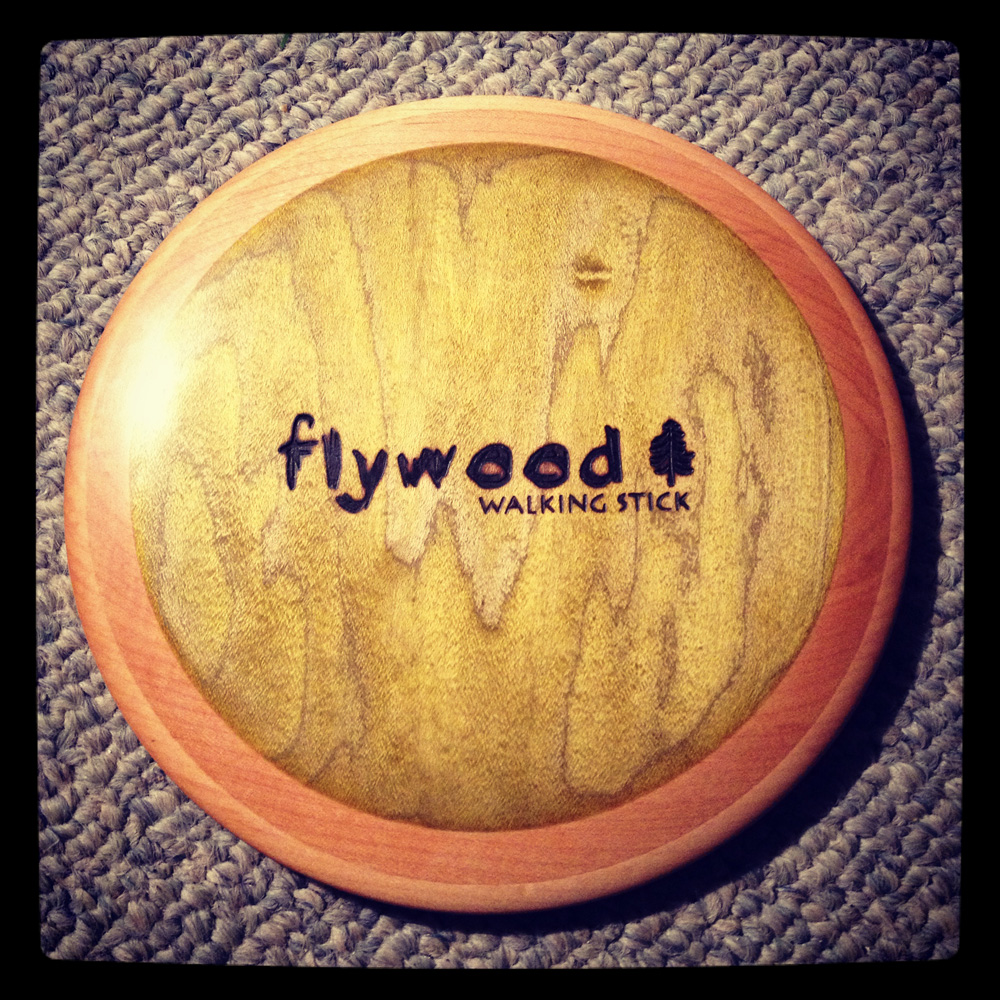
The Flywood Walking Stick is a fun disc to throw and the sounds it creates are quite unique.

The Pennsylvania-based company sent Rattling Chains three discs to test — all the driver called The Walking Stick. Though I had learned about the company a bit when we ran the story about Flywood, it still wasn’t the same as seeing what the disc was all about.

As many may know, I’m not a long thrower. So I usually go based on feel and how things seem to come out of the hand on a throw when trying out discs.

The Walking Stick was quite interesting and I really liked the feel of it. I was worried at first because it’s wood. But it actually felt lighter than a regular disc. It had a nice look and the sound is something pretty cool, too. I also liked the way it came out of my hand. I didn’t think it felt all that different with discs I normally play with and thought it remained comfortable throughout the motion and release.

As for how it flies, it did what many drivers do for me (as a right-handed-backhand thrower), it got out 200 or so feet and broke hard to the left. I threw it many times and got some nice throws, but for the most part, it broke hard.

To a better thrower, I can imagine it being something really to use during round not sanctioned by the PDGA.

The only thing I’m curious about? What happens in six to eight months if the disc gets beat up some? Is it like a plastic disc where the flight characteristics change? Or does it hold the same line. I’ll be excited to find out.

The disc itself needs a little more care than the regular plastic. One needs to clean it and wax it sometimes to make sure it stays protected. The discs come with the wax needed.

I’m not going to lie, either — one of the coolest things? The sound. When it hits a tree or the chains. It’s not what a disc golfer is used to. There are times it sounds like a baseball bat hitting a ball. Definitely cool and one will be easily able to tell where the disc may have gone based on the sound.

flywood_4

The wax is needed to keep your disc healthy.

Eventually, I hope to try out the mid-range and putter offered by Flywood. I think those will be more toward my style and something I can use a bit more. I will keep working with this disc in the hopes of being able to utilize these discs for many casual rounds.

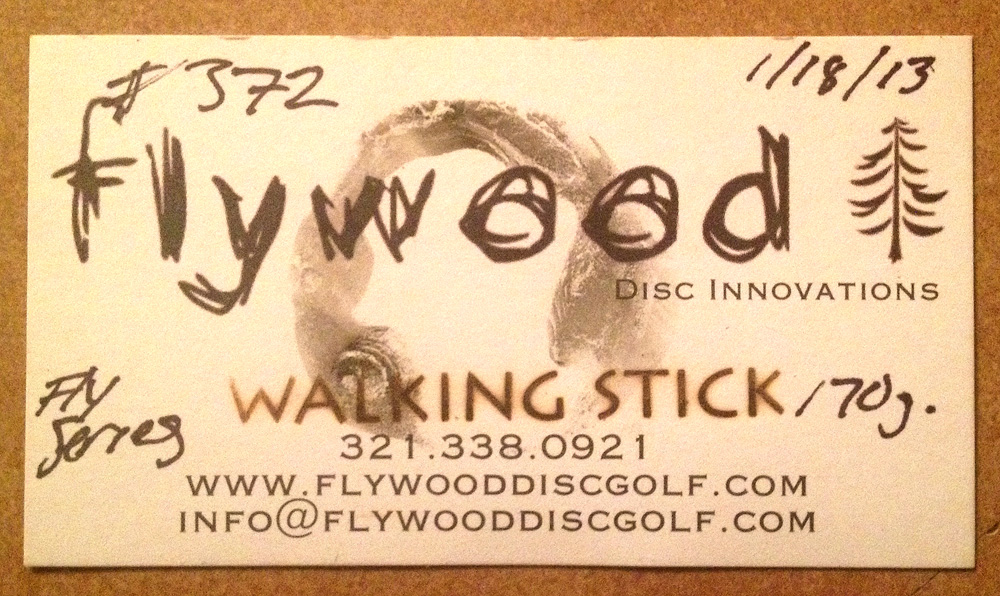
Though they are a bit on the pricey side ($30 per disc), the discs are made by hand and show the personal love. Our discs came hand numbered, including with a card showing the information about the disc. A great touch that separates smaller companies from the big boys.

In the end, it’s a cool disc. Is it perfect? No. But I’ve yet to see a perfect disc. It’s a solid addition to a casual bag and the quality is unmatched. Mix that with the personal touches and what the disc can do, and it’s definitely worth having.

Steve Hill

I usually get pretty excited for any new discs we get to review for Rattling Chains. After all, when a company takes the time to recognize what we do, and we get to try something for free, I’m all for it.

But I don’t think any release – with respect to other manufacturers, of course – had me as excited to get to the mailbox as the Flywood Walking Stick.

After reading a little about the discs online, and then watching the video on Flywood’s website, I had a feeling we were going to be receiving something special. True, the disc isn’t PDGA-approved, which might be a drawback for some. But, with a two-year-old at home and the family commitments that come with that, I play maybe one PDGA-sanctioned event per year. As a result, I can throw whatever I want and not have to worry about it fitting the standards.

Flywood's discs come with a nice and personal touch.

Flywood’s discs come with a nice and personal touch.

And I am glad I don’t have to do that, because the Walking Stick is a tremendous piece of hardware.

The disc I received had a delicious, candy apple red finish to it, and it weighed in at 172 grams. However, in the hand it feels much lighter than a plastic disc of the same weight. Perhaps it is due to the material, or the multi-ply construction – I’m not sure. But it feels light in the hand.

My main concern with this disc – which I am sure others are worried about, too – was that it would feel uncomfortable ripping out of my hand on a drive. With it being made of wood, and therefore being less flexible, I was concerned that it might result in some distressing callouses. I am happy to report, though, that the finish on the disc, particularly on the rim – is smooth and easy to release.

As for the flight, this may be one of the only discs that I have ever been able to make replicate its flight chart. On a good rip, the Walking Stick would fly dead straight for about 65% of the flight, then start to make a gentle, late turn before fading out at the end of its ride. When I didn’t really dial it in, it was still plenty useful, with a straight-then-fade flight reminiscent of an Innova Teebird. It can easily be a workhorse off the tee.

However, out of the box it is still too stable to hold an anhyzer line. As a result, it was great for flex shots, but certainly couldn’t be a one-disc-wonder. Rather, an understable complement would pair nicely with it.

Flywood's discs come with a nice and personal touch.

Flywood’s discs come with a nice and personal touch.

There is, though, one major downside to this disc – it is too pretty for me to want to throw. I’m worried about clanging it off of the rocks that line some of my home course’s fairways and taking dings out of it. I just want to keep it in mostly pristine condition and hang it on the wall to stare at.

Maybe it is time to add another Walking Stick to the collection – one for the bag, one for decoration. It truly works well for both purposes.

Jack Trageser

When I first became aware of Flywood disc golf discs, my initial reaction was intense curiosity. Wooden discs that are meant to be thrown and used in actual disc golf play? I always get excited about anything in disc golf that truly breaks new ground.

However, I’m first and foremost a competitive player, and after a quick check I realized that a disc made of wood would never be approved by the PDGA for use in sanctioned events due to the inherent rigidity of the material. Right away it was clear that these discs are not going to be “game-changers” that break records in terms of distance or control. That would be pretty cool though, wouldn’t it? It would be the opposite of what happened in ball golf when titanium drivers replaced woods.

Regardless of my discovery that wooden discs would not be vying for a spot in my competition bag, I was still eager to see how one looked, felt and flew. When mine arrived in the mail, I have to admit I was impressed.

flywood_2

The Flywood, tombstones.

The company’s driver, The Walking Stick, came packaged with Boobee wax, which is used to improve the grip, and, I suspect, when applied to their putter it also helps (at least a little) to grab the chains. I’m not sure, but guessing that is also verboten according to PDGA rules as well.

Another great touch is that the disc has a card attached that actually numbered my disc (#371) and dated it as well. This was a great reminder that I didn’t just have another disc on my hands, but a handcrafted work of art. I’ll finish by returning to this point, but for now I’ll just say this is where I think Flywood can get the most traction with its products.

When it was time to take my Walking Stick out for a test, I picked an area where it would land on nothing but soft grass. I know, ideally, I would have tested it for durability as well as flight characteristics, but I just couldn’t bring myself to purposefully inflict damage on such a work of art.

Unfortunately I don’t have much positive to say about the flight of the disc, except that it did indeed fly like a golf disc, and it was reasonably stable. But compared to plastic or rubber discs, it didn’t seem to have much sail or float to me, wanting instead to plunge back to earth as soon as the energy I put into the throw had dissipated. Also, as the disc released from my power grip, there was noticeable discomfort. The inner edge feels smooth enough to the touch, so I suppose this is due to the rigidity of wood.

It seems to me that Flywood has two different markets for its disc — the first is a small subset of the disc golf crowd, players who care deeply about the environment and desire that as many products as possible that they use and consume be completely natural. If you love disc golf but have issues with petroleum-based plastics, these discs are your answer to being able to make an already environmentally-sensitive sport even more so.

The other market for Flywood — and the one I’d think could make these discs quite popular — consist of people who feel that the flying disc is an ideal subject for all forms of art. I love the idea of a hand-crafted disc, especially if it’s master-crafted the way these are. If you’re the type that collects all things disc golf, the price tag of $30 is well worth it for what you get. Just imagine having a perfectly shaped wood disc on your wall along with all your other wall discs. Which one do you think will catch a visitor’s eye first? Exactly.

If you have any comments, questions, thoughts, ideas or anything else, feel free to e-mail me and the crew at: pj@rattlingchains.com. Don’t forget to follow us on Twitter and like us on Facebook!

Poll 53: Giving a good image

We’ve been dealing with some interesting topics this week.

And, being we covered the family and cliques last week, we’re going to keep on that same page a bit and talk about how the old regulars give off the image of this sport to newbies or non-players.

weekly_poll

But, as always, we’ll get to that in a moment. First, let’s go back to last week and see what people had to say about that poll.

We wanted to know how you perceive disc golf.

There were 100 players who voted in this poll. Of that group, 63 (63 percent) said the sport is made up of cliques. The other 37 (37 percent) said it was one big happy family.

This was definitely quite a gap.

Let’s get some people’s opinions on this to expand on this vote.

Continue reading

Out of Production, but still producing: disc value is in the eye of the holder

If you frequent online enclaves such as the the Disc Golf Collector Exchange group on Facebook, or the similar forum pages on Disc Golf Course Review, the acronym O-O-P may be well known to you.

It stands for out-of-production, which refers to discs no longer being produced by their manufacturer.

jack

This, of course, is significant to collectors because it means a disc is in limited supply and, therefore, of potentially higher value.

It means something to me, too, but for a different reason. While collectors get excited about O-O- P, I get nervous.

Having played disc golf for more than 20 years, I own close to 100 discs, not including the stock I have on hand for use in my School of Disc Golf. But I would not consider myself a collector. Possibly a bit of a historian, and, more than anything else, an accumulator. But as collectors are thought of as those who like to build a collection either as a hobby or for profit, I can safely say that isn’t me.

The author collects only discs with personal significance. Among this group are his first ace, most memorable ace, a disc to commemorate the opening of the first course in S.F., a NorCal 'Hotshot' disc awarded for the low round in a tour event, and a prototype DGA Blowfly signed and given to him by Steady Ed Headrick. Blurry photo by Jack Trageser

Only discs with personal significance are in Jack Trageser’s collection. Among this group are his first ace, most memorable ace, a disc to commemorate the opening of the first course in San Francisco, a NorCal ‘Hotshot’ disc awarded for the low round in a tour event, and a prototype DGA Blowfly, signed and given to him by Steady Ed Headrick. (photo by Jack Trageser)

I have some discs that would go for much more than their original sales price if I ever decided to sell them, but all the discs in my possession that I value the most are dear to me for one of two reasons — either I have a sentimental attachment to them – like my first ace disc or a prototype signed and given to me by Steady Ed Headrick; or they are out of production and I still use them to play.

It’s the second reason that is the main subject of today’s post. Irreplaceable actually retains its literal definition when the object that is difficult or impossible to replace is actually serving a function rather than just gathering dust (in it’s dust cover, of course). The mere thought of losing a key disc in your bag and not being able to replace it can cause little beads of sweat to form on one’s forehead — am I right?

Continue reading