Exclusive: The chains talk back

(Editor’s note: Sometimes there isn’t anything in the queue and I’m blank so I start thinking about silly things I can write about. This is one of those stories…)

By Disc G. Basket, Esq. — Contributing writer

I’m sick of it.

You see, me and my brethren are sick and tired of you disc golfers treating us like crap or second-rate citizens.

Rattle those chains, you say. Make them sing, you say. Throw it harder and make it stick, you say.

A disc golf basket speaks up — and makes it known that rattling the chains is a painful thing!

Apparently, you don’t realize that we baskets feel what you are doing.

You don’t think it’s a coincidence that a perfect putt pops into the chains and then lands on the ground, do you?

We have to deal with a lot, you know.

Sometimes, we’ll have to smell some of that herbal stuff that some of you players bring around. You know, not all of us like to smell that stuff! And booze? How many times are you going to leave empty beer (or soda or something else) bottles in our baskets?

Our baskets aren’t made for that or other trash that people can leave behind. Now we realize that it’s not just disc golfers who leave stuff in our baskets, but they do.

People sometimes also sign us after we’re kind enough to allow an ace. Really? Sign your disc and move on. For those of you kind enough to come out and wipe all that graffiti off us, we thank you.

Back in the day, when we were first installed, we’d be treated like Kings and Queens.

Players would come by in awe of us. Kind of like a new baby. Unlike a baby, however, soon you were whipping pieces of plastic at us. Sometimes, there were sharp edges.

Continue reading

Opinion: Low voter turnout for PDGA election not good for game

Where are all the disc golfers?

That question, by itself, is probably pretty easy to answer. Head to your local course and find a few.

With disc golf being a fast-growing sport, I would think there would be a lot more disc golfers interested in the game as a whole, not just throwing discs around the course.

The reason I ask this is because of several things I’ve noticed lately. One is the statistics for hits from this website. We go up and down quite rapidly. Part of that, of course, is pinned on us going to basically three stories per week. But even before that, we saw a slight drop.

Is it content? Is it because it’s the summer and more people are outside?

Who knows.

That, to me, isn’t alarming. See, we do this because we love to do it and if people read and comment, that’s a bonus.

Then there’s the Professional Disc Golf Association (PDGA).

The PDGA is the governing body of our sport. If you have played in sanctioned events, you know all about the PDGA. In fact, I’ll bet most of you who read this blog know what the PDGA is and what they do (for the most part).

The PDGA is ruled over by an elected board of directors. This board helps shape the sport as a whole. The board includes professionals and amateurs and people who have made disc golf their life.

The association held its annual elections for three board seats through the month of July. Members had that month to cast their ballots online. I first got notice in early June that the PDGA would be sending its ballots out July 2, so I knew it was coming.

On July 2, I received my ballot. At that point, I knew I would vote (I always do), so I put a reminder on my calendar for the final date. I wanted to see what would happen through the month.

Continue reading

Disc golf terminology has my head spinning

By P.J. Harmer — RattlingChains.com Staff

Hyzer. Anhyzer. Understable. Overstable. Pancake. Worm burner.

The one thing about disc golf is the amount of terms that are used in the game. From terms describing discs to throws to players. It can be overwhelming to newer players, especially when they are playing with more experienced players who are throwing these terms around like it’s nothing else.

It can be like a foreign language.

Better yet, think of yourself as a parent learning to text. You get one from a teenage son or daughter with something along the lines of…

“OMG like i thought u were goin 2 play frisbee 4 fun. u r way 2 serius. lol”

Um…

Exactly.

The reality is the game of disc golf can be very technical. So when an experienced player — or someone who just knows the terminology — starts talking about how your throw is well if you used an overstable disc and let the hyzer naturally take its course.

Huh?

I’m simple when it comes to terminology – in all aspects of life. I don’t like to use jargon or anything like that in pretty much all I do.

Continue reading

Review: ScoreBand makes scoring a bit easier — once you get the routine down

The ScoreBand is a worth addition to any disc golfers bag.

(Editor’s note: Two people associated with Rattling Chains tested out ScoreBand, a scoring watch that also works for tennis and other things. The first part is by P.J. Harmer).

I’m a stat junkie.

No matter what I do, statistics fascinate me. Whether it’s softball or finds in geocaching or comparing scores on the disc golf course, I really get into it.

One thing with disc golf and me has always been keeping the score. Though there are many phone apps or pencil-and-paper ways of keeping score, I’ve been in search of a quick and easy way of keeping score as I play a round without fumbling with my phone or a pencil.

Insert ScoreBand.

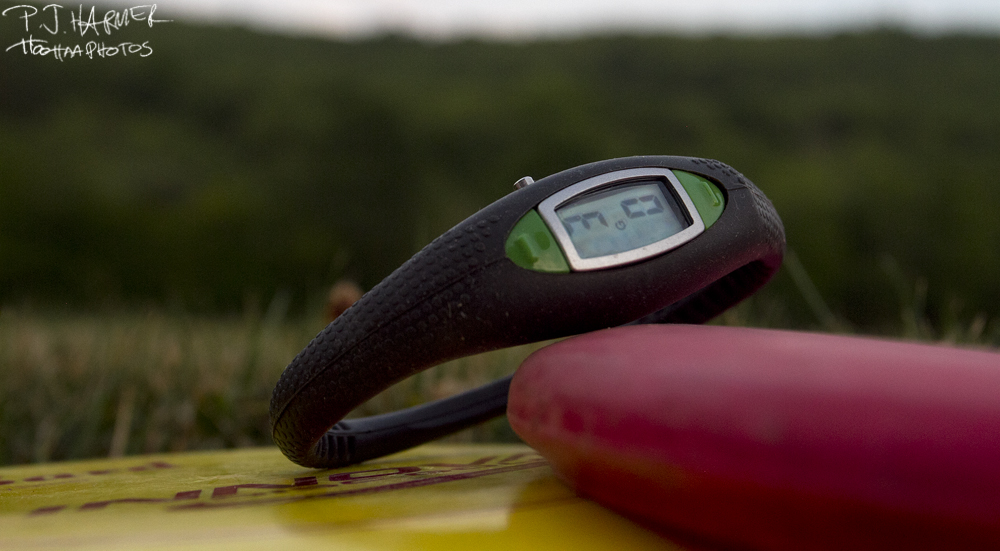
ScoreBand is a rubber wristband/watch. The company calls it a “revolutionary quick-touch, 4-in-1 scorekeeping wristband engineered for sport.” It stood up to the challenge, too.

First, the construction is a one-piece rubber wristband. There are several sizes and colors to choose from, so you’ll be able to find one (or more) that fits your style. It’s comfortable to wear, though I’m not sure I could wear it all the time as I did notice it was there and with the rubber band, it could get a little tough to deal with at times.

Still, this band is easily worn for a round or two of disc golf. I wore it on the opposite wrist of my throwing hand, so I never knew it was there. Also, it made it easy for me to click the score.

I can’t comment on how this would be for ball golf as I always avoided wearing anything on my wrists when playing. I’m sure if people were used to wearing anything when swinging a club, this wouldn’t bother them. The same could be said for tennis.

The ScoreBand has four modes:

  • Golf
  • Tennis
  • All sport
  • Time

Those are four excellent items as it allows you to get multiple uses from one wristband. For golf, it keeps your hole score as well as your cumulative score. For tennis, keep game and set scores.

Though this is something that will be a permanent addition to my disc golf regiment, the all-score mode might be the most intriguing part of this band.

As the company notes on its site, there are many uses for this mode — including some other disc and ball golf functions, such as keeping putts, fairways hit or greens in regulation.

  • Other items that the watch can be used for:
  • Pitch counter for baseball or softball
  • As a head counter where attendance is needed
  • To count inventory
  • Keeping track of how many times you take medication
  • Lap counter

Truthfully, the options are endless with that mode.

Using the band is easy. There’s three buttons — two on the display and one on the side. Once you get the hang of how the watch works, it’s simple to use while playing. The key is remembering to use it.

Though I don’t often do it, perusing the instructions is a smart move and messing with it for a while before taking it out will help you get used to the controls so you can work it while on the course.

ScoreBand is a comfortable band that is easily used throughout a round.

The best part in my eyes?

It keeps your score as you go along. So if you click it after each throw or shot, you can see what you’ve done on each hole. At the end of the hole, add it to your overall score and you’ll have a clean slate for the next hole.

My only issue is it can get a little confusing on how to take your round score and add it to your cumulative score. You have to hold one of the buttons down to have it do this, but in the end, once you get used to it, it shouldn’t be an issue.

Though I love using my phone as a score card, the reality is it can sometimes get cumbersome to take the phone in and out of your pocket, get the screen up and type in scores. In the amount of time that takes, I’m at the next tee or shot with the score already in my watch.

If you are looking for more in-depth stats, the phone apps are probably the best. But if you are out playing and just want a quick and effective way to keep your score, this really is the way to go.

ScoreBand is $29.99, but it’s durable and something all disc golfers should consider having if they want a nice and easy way to keep score during rounds.

Jack Trageser

One thing in particular piqued my interest when asked to review the ScoreBand as a method for tracking disc golf scores and statistics — I wondered if it would work for someone (namely, me) that has made a persistent effort over the past several years to remain ignorant of his cumulative score during a round.

As I’ve discussed before, a primary disc golf philosophy that I espouse centers on playing disc golf in a vacuum. In a nutshell, that refers to being completly immersed with the current shot rather than letting your mind wander about things like past shots and holes, future shots and holes, other games, what’s for lunch, and especially the distraction that pertains to this review . . . total score.

Keeping that in mind, I’ve yet to come across a method for recording my score among the traditional pencil-and-card and smartphone apps. I’ve trained myself to lock each shot on each hole into my memory banks without tallying the total until the round is over.

When I heard how ScoreBand works, however, I thought it might be the first scoring method to allow me to record my score using a device more reliable than my own grey matter — without letting the insidious organ get in its own way.

The design sets it apart from other scoring tools by being something that is worn, rather than carried, taken out and put back away repeatedly. Plus, it has a watch function, too, so you can wear it instead of your normal watch.

ScoreBand’s method of keeping track of the score lends itself to my personal idiosyncrasy as much as its ergonomic design. The user hits one button for each stroke to keep score on the current hole in the upper display, then presses and holds another button to add that hole’s score to the total score in the lower display.

Scoreband is a very cool concept and could help many people with disc golf scoring and many other items.

In theory, this lets a player hit the buttons the required amount of time for strokes and hold it the right duration of time to advance from one hole to another without having to even look at the screens and remain as oblivious as he or she wishes to be where total score is concerned.

In practice, however, I found using the ScoreBand to not be quite so simple (remember, these issues are magnified by my desire to not know my cumulative score during the round).

For starters, there is the issue of when to hit the button to record each stroke. Do you do it right after each throw, or wait until the completion of the hole and hit the button multiple times? In my case, during the five test rounds I played, settling on a system was not easy. In fact, it never happened. I tried to do it throw-by-throw, then would realize on the next tee that I had slacked, requiring me to enter all the strokes on that hole at one time. And it got worse, as a few times I realized I had forgotten for two entire holes.

I guess that can happen with other scoring methods as well, but having to hit a button for each stroke makes it more of an ordeal.

The upper display shows the stroke count for the current hole. When the hole is complete, you press and hold a button and the hole total is added to the round total on the lower display, while the upper one resets to zero. If you forget to record a stroke, or a hole or two, there is no way to tell which hole you last recorded successfully. It’s also an issue for those who want to know how they did hole-to-hole as at the end of the round all you have is total score.

The bottom line is that ScoreBand delivered in the main way I hoped it would. As a stretchy band worn on my non-throwing wrist, it was accessible and out of the way. Once I learned how to use it, I could hit the buttons without looking at the screens, enabling me to avoid knowing my score.

But it either takes time to get the process down to a routine, or I’m just inept at it. Of the five test rounds I played, my total came out wrong twice. I rely on my memory-based compilation after the round is over. Since I can recall each shot in my mind’s eye, it proved my use of the ScoreBand wasn’t perfect. I don’t think the device was faulty — it was a combination of my attention span and the user interface.

In January, ScoreBand was recognized as the Best Product Concept at the Professional Golf Association merchandise show. The people who awarded ScoreBand put more thought into things like that, so if you you’re like me and want a method for scoring that is handy and unobtrusive, ScoreBand may be for you.

If you have any comments, questions, thoughts, ideas or anything else, feel free to e-mail me and the crew at: pj [at] rattlingchains.com. Don’t forget to follow us on Twitter and like us on Facebook!

State of the Chains Address

I feel that with how slow things have been here recently, I owe our readers a bit of an explanation — hence the State of the Chains Address.

First, my apologies for no poll this week. I am skipping it this week and it will return this upcoming Monday. I’m low on ideas for polls and have received a few ideas, so I need to get them all ready to go.

As for how things have been…

One thing about this site — and the writers — is we came out of the gates without any pace. By that I mean we had many ideas and stories and we just kept putting them out day after day. We tried a few things and when they didn’t work too well, we scaled it back or replaced it. Things were good.

For those of you who write, you might see where this is going.

It’s one thing to blog, it’s another when it’s a niche topic. I have a personal blog on top of Rattling Chains. At times, it’s much easier for me to whip out stories there because it covers a variety of topics. Here, it’s disc golf.

Continue reading

Photography and disc golf: Action doesn’t have to be hard to capture

Capturing action shots with disc golf is always cool, but one doesn’t need high-priced camera equipment to capture the essence of the game.

(Editor’s note: This is the first in a series about disc golf photography. The rest of the series will continue in the coming weeks.)

By P.J. Harmer — RattlingChains.com Staff

I’ve been lucky over the years to be able to submerge myself into photography. From having a dark room growing up, to working for a weekly newspaper where I had the chance to learn all facets of a camera.

Over the years, sports has always been a big part of my photography. Whether it’s being close up at a baseball game or trying to find the right angle during a football game, sports photography can be tricky.

This post, however, won’t be about the technical parts of disc golf photography (I’ll save that for another day), rather the basics of what to look for, where to stand and other things you can do.

The reality is cameras are more and more affordable, so everybody can enjoy taking disc golf photos. And with camera phones (such as the iPhone) getting better and better, the ability to take disc golf photos is becoming easier and easier.

Continue reading

Breaking up is hard to do

We've had some good times together, haven't we?

By P.J. Harmer — RattlingChains.com Staff

I know separations can be messy.

And I hope this one won’t be. After all, we’ve been so good to each other over the past few years. I’ve coddled you, at times. When you went storming off into the woods or slammed yourself up against a tree, I ran after you and wanted to make sure you were safe and sound.

You were one of my first, too.

Oh that special moment. The first time I felt your wonderful underside and gripped you as I stared down a beautiful fairway.

It was love at first touch.

I remember the feeling of knowing I had you all to myself, too. You had this Buzzz to you. You were oh so pretty and when I really needed help, you were always there for me.

Continue reading

Opinion: One giant step — and statement — by women disc golfers

For something to be successful, it often takes small steps.

This past weekend, the women of disc golf didn’t appear to want to make a small statement. Instead, as a collective unit, more than 600 women made note that they were there to play the game.

Bravo.

Several months ago, when I first heard about the Women’s Global Event, the gears in my brain started to turn. How could we as a disc golf blog help to not only promote this wonderful event, but also work to help get women’s voices out there?

A women’s week came to mind.

I have to be honest, too. I never even connected it with Mother’s Day. In fact, it was Val Jenkins who noted that to me in an e-mail. Though she promised she wouldn’t tell “mom” about my gaffe of not realizing that WGE and Mother’s Day were the same weekend, I’m coming clean.

That just made this week at Rattling Chains more special.

As this idea grew, I spoke with the person who created our logo — Ben Coury — and asked him about switching some colors. He did it quickly. I looked at our blog theme and realized I could change the color to match.

Women’s Week at Rattling Chains was born.

Continue reading

What’s a 9-hole course worth to you?

Nine-hole courses can be as scenic and as challenging as 18-hole courses. (Note, this image comes from an 18-hole course)!

Is a 9-hole course worth anything?

It’s amazing to hear someone say that a 9-hole course isn’t worth the land it’s on. But I’ve heard that — more than once.

This came up recently on one of the local club’s message boards. There was discussion about a 9-hole course and one of the area players was quite adamant about the waste that is a 9-hole course.

Someone asked about a possible course and if it would start as a 9-hole layout. They were told that it would be 18.

A response came about “it must be” 18 holes. And that “most people” think the 9-hole courses are a joke. Nobody plays or cares about them. And, of course, no tournaments.

And being this person said it, it must be the truth, right?

What followed was some banter where people defended 9-hole courses and, of course, couldn’t sway the naysayer.

Apparently, it’s a mental exercise for people to argue in favor of a 9-hole course, he noted. Yet, his brain doesn’t have enough cells to argue with “this sort of craziness.”

Then, as if this was a court case with closing arguments, it was noted that “Disc golf courses have 18 holes. Period. More than 18 is even better.”

Quite the interesting situation, I’d say.

The benefits of a 9-hole course are easy enough to explain — it’s a place for people to play, it gives options, you can get through a 9-hole course quick enough and, if in a good spot, it can be just as challenging and scenic as an 18-hole course.

The fact that one person feels his opinion is the ultimate say on this matter doesn’t irritate me. That happens in everyday life. But the realization here is that 9-hole courses do have their place in this game.

Continue reading

Taking disc golf to the streets (and anywhere else you can set up a basket)

One of the ideas a couple of us had when we initially started this disc golf blog was to do some urban disc golf.

We thought it would be fun to take a portable and explore, and to see if we could come up with some fun video.

It might be around here. Elsewhere. Travels. Whatever.

But urban disc golf is new to a few of us. We’ve tried a few things and screwed around with some videos. And there’s going to be more, hopefully. Especially now that the weather is turning good.

But what makes for a good urban disc golf video?

A few months back, four of us got together to do a little testing of the urban disc golf idea. We have ideas on how to expand it and such, but we wanted to do a few things to see what kind of reactions we could get.

We started in downtown Albany (N.Y.) and wandered around. It wasn’t the busiest day, so that made it nice to be able to move around and see what we could get away with.

And get more ideas.

This is one we did. The lady in the bus stop definitely seemed to wonder what the heck we were up to.

Is this the best urban disc golf video? Of course not. But we are working to try and make things better. Maybe get some more people. Maybe try a couple of crazy spots. Maybe things can get better.

Continue reading