Instruction: Building blocks of basic backhand technique

By Jack Trageser — RattlingChains.com Staff

Disc golf is still enough of a niche sport that by the time most of us are ensnared (like a putter caught in the inner chains of a Mach III) by an obsession to get better, we’ve already been heavily exposed to other more mainstream sports.

That reality has definite advantages for me, as an instructor, because it helps when I’m teaching a disc golf concept related to technique (or even mental stuff) to be able to draw analogies between disc golf techniques and those of other more familiar games. If someone has already learned a similar motion, it’s easier to recall that motion and apply it to disc golf than to learn it completely from scratch.

Case in point, my first session with Rattling Chains’ lead blogger P.J. Harmer.

P.J. spoke of the frustration of not being able to throw as far as he wanted or thought he should be able to throw — nor as accurately. Without actually watching him throw live and in person, I had to rely mostly on the spoken and written words we exchanged on the subject in choosing my advice for him. However, I knew a couple other things that would likely prove useful.

First, players in the earlier stages of the disc golf learning curve usually make many of the same common mistakes and therefore see many of the same negative results from those mistakes. Second, P.J. has talked on many occasions of being an avid softball player, so I knew right away that he would be able to easily understand the comparisons I like to use between throwing a disc golf disc using the backhand technique and proper batting technique in baseball.

Weight transfer and balance

Probably the most common mistake I see players of all levels make with the backhand shot has to do with transferring weight from the back foot to the front foot.

Figure 1: The stick in this photo illustrates the line on which players pull back the disc and throw that results in shots that pop in the air and don't go very far.

A good backhand throw derives most of its power from the back, torso, and legs rather than just the arm. In this way (and some others, which we’ll cover soon) throwing a disc backhand is just like swinging a baseball bat with the goal of hitting the ball with any kind of power.

In both cases you’re standing at a 90-degree angle to the direction you want to throw/hit. And in both cases you want your weight to shift from your back foot to your front foot at a precise critical time. With baseball, that time is a fraction of a second before the bat hits the ball. With disc golf, it’s right as the disc is passing your body mid-throw. Any sooner in either case and you’ll rob yourself of all that power you had coiled up from your legs and torso.

Using the baseball analogy, think of what a hitter looks like when he’s way out front on a change-up or curve ball. And in the case of a backhand throw in disc golf, you’ll also likely mess up your balance and lose accuracy as well as distance.
Continue reading

Review: Discasaurus app for iPhone

By Kevin Morrow — Special to RattlingChains.com

Let me start by saying I hate phones.

Especially cell phones.

As soon as I answer a call, I’m looking for a chance to end it.I never carried a cell phone and I waited for about two years before I bought an iPhone. But I use it as a handheld portable data device, which just so happens to take calls. Almost immediately, I began looking for disc golf scoring apps.

Discasaurus

I have used several scoring apps. The earliest ones were just scorecards that had a few extra features. iDiscGolf, Scorecards, Disc Golf Tracker and the PDGA app (which I use for tournament rounds) are some that I have tried.

And, of course, Discasaurus.

The apps creator — Dave — has said the app is disc golf score keeping done right.

After more than 150 rounds with the app, I tend to agree with him.

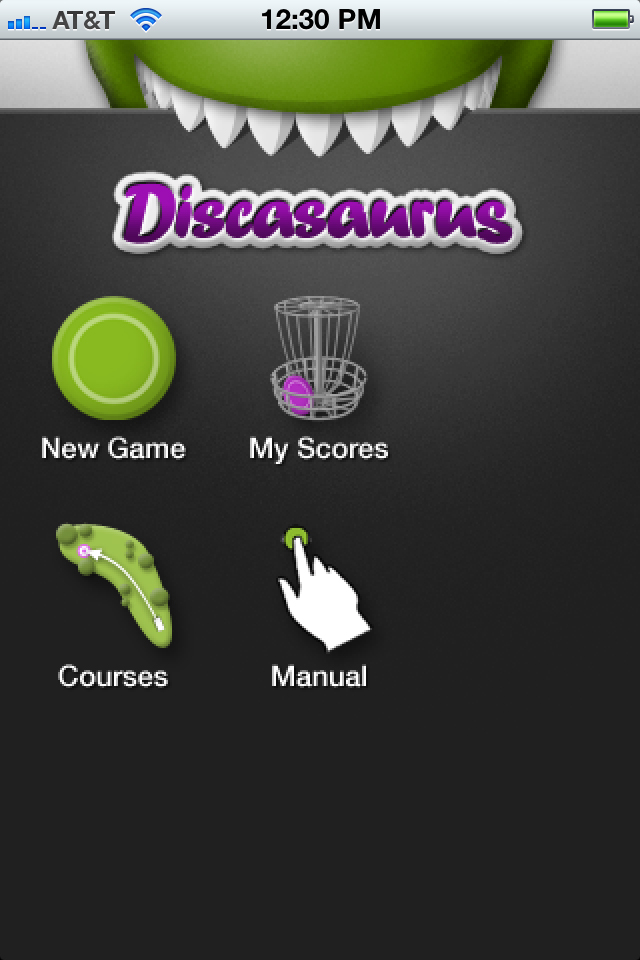
Discasaurus is a free app for the iPhone. It’s an easy-to-use scorecard that also has a course locator. The app, which was released June 21, 2011, is integrated with a website where players can upload scores and keep track of scoring trends.  The next update is slated to happen within the next few weeks

I downloaded this app about two weeks after it was released. Since then, it’s become my primary disc scoring app. The app features about 2,700 courses, including ones in the United States and 15 other countries. There are also about 5,300 registered players and there is about 50 new players daily registering accounts. Between 75-100 scores are posted daily.

Continue reading

‘Non-Stop’ opportunities, growth on professional tour

It's a non-stop tour for four PDGA pros this summer.

Tens of thousands of miles. Four professional disc golfers. One van.

No, this isn’t the premise to the newest goofy Adam Sandler film. Actually, it’s the framework for the Non-Stop Disc Golf Tour, and it is serious business.

OK, so it isn’t all serious business, but there is plenty of work involved, nonetheless.

The brainchild of 2008 world champion David Feldberg and 2010 United States Disc Golf Championship winner Will Schusterick, the foundation of the tour is simple: The two pros – along with fellow hotshots Nikko Locastro and Cale Leiviska – cross the country in an RV, holding school clinics during the week and closing out their visits with weekend tournaments. From pounding the pavement for sponsorships to cleaning up the remnants of their events, these four and their crew arrange these outings with the common purpose of growing the game of disc golf.

Passing the Torch

The genesis of the tour, according to Feldberg, came from the close relationships the players already had with one another.

“The idea of a tour this year…I think that was a combination of all of us thinking together, because we’ve been traveling together a lot,” Feldberg said. “I’ve been thinking about it for years. I’ve been building my career around the idea of being able to go to schools and teach clinics, so it works out well.”

Dave Feldberg works with another player at a NSDG clinic. (photo courtesy NSDG via Facebook)

Besides teaching new players about the game, Feldberg is also using the tour as a chance to educate the younger professionals and usher in the next era of the game.

“I just figured that it’s almost a passing of the torch,” he said. “I figured I’d take out some young guys and make sure they’re the next best.”

That torch isn’t being passed just from Feldberg to the youngsters, though.

“I think we all have something to learn from each other, even though I haven’t been around as long as everybody else has,” Schusterick said. “I’m definitely picking up a couple of their tricks and a couple of things to add and always build my game.”

Feldberg agreed that even he, as the seasoned veteran of the group, can pick up some tips from the young guys. He also sees this as a necessity to keep up with the rapid acceleration in the quality of professional disc golf currently being played.

Continue reading

Poll 10: Are you a PDGA member?

It’s been a little while since our last poll, so it’s time for a new one.

Before we hit it up, let’s check out our last one which asked if you followed the National Tour.

Though things started out a bit different early, it ended up showing that the majority of those who voted do, indeed, follow the tour.

Of the 69 who voted, 40 (58 percent) said yes. Next was 15 people (22 percent) who didn’t know there was a tour and then 14 (20 percent said they didn’t follow it).

Let’s see what some of the readers had to say.

Ryan Clements noted:

I’m aware that there is a tour. It’s just not something I follow.

I’ve been told that, personally, by many people. It’s good that people are aware of it, but for the tour to have impact, casual players will eventually have to have an interest in watching etc.

Jorey C. McComas said:

Love watching the Pros. I enjoy watching a tourney and then trying to play the course as close to their lines as possible. Doesn’t work out on the holes where you need a 400+ throw to clear their line, but fun trying the shorter stuff.Love watching the Pros. I enjoy watching a tourney and then trying to play the course as close to their lines as possible. Doesn’t work out on the holes where you need a 400+ throw to clear their line, but fun trying the shorter stuff.

That’s one big reason I like to watch the Tour — especially in person — is their ability to throw these discs. It really is amazing watching what they can do with one.

Continue reading

Women’s Global Event attracts more than 600 players

Angelie Hill gets a high-five from her father and tournament director Ray Hill at the JTown Disc Golf WGE on Saturday. (photo by Jenny Cook)

All signs point to the first PDGA Women’s Global Event being a resounding success.

Paige Pierce, who won the 2011 World Championship, earned the overall Open title, according to unofficial results on the PDGA website, as of late Sunday afternoon.

Pierce, who played in the Central Texas Hyzer Honey’s WGE, had rated rounds of 983 and 991 for a 1974 total. Her average was 987.

The Daisy Chains Tournament in Watsonville, Calif., which had 52 players, put on its WGE event with a serious woman’s touch. Everything from men acting as scorers, hand sanitizers, candy, daisies all over the course, poker tables, player bags with interesting items and, basically, a fun atmosphere.

Tournament director Christine Hernlund said the tournament had 18 scorekeepers, four men manning the grill, many volunteers and the group used 48 pounds of meat at lunch.

Women from this event placed in the top two in three classes — Open, Advanced Masters and Intermediate.

On the other side of the country, Jennifer DeVries served as a tournament director for the first time at the Disc Chicks Throw Down at New Quarter (Williamsburg, Va.)

“Wow was it an experience that I really enjoyed,” DeVries said.”It was such a great time for everyone involved.”

Continue reading

Suzette Simons keeps giving back to the game

Suzette Simons at the 2011 United States Women's Disc Golf Championship in Round Rock, Texas.

Family first.

This simple edict may be a gentle reminder about one’s priorities in life, but when reflecting on bringing more women to disc golf, Suzette Simons said she thinks it might be a means to continuing the sport’s growth.

Simons is a key member of the Southern California disc golf family. Through her work as the Membership Director of the Southern California Disc Golf Association (SCDGA), as well as her employment as Customer Service and Promotions Specialist for Innova Champion Discs, she said she understands what brings all players – women included – to the course.

“It seems most women come into the sport, just like most men, through friends and family,” Simons said. “Family play brings not only more women to the sport, but junior players as well. As more families play, more women will play.”

Since first trying disc golf in 1996, Simons has dedicated herself to her local scene, be it in Iowa where she first played, or in Minnesota, where she served for two years as president of the Minnesota Frisbee Association. At each depot in her disc golf life, she has always made time to give back to the community.

“I was hooked immediately, especially to the competitive side, including league and tournament play,” Simons said of her origins with the game. “I also became active right away volunteering with local clubs and running events.

Suzette Simons at the table of the 2009 United States Masters.

“It is just my nature to volunteer.”

Her work in giving back to the game has centered mostly on attracting women and children to the sport through hosting clinics, tournaments, and league events. Simons’ desire to contribute also finds her on the PDGA Competition Committee and as a major supporter of EDGE, the Educational Disc Golf Experience that helps put the game in kids’ hands.

And while Simons is a competitive player by nature, she doesn’t necessarily see competition as a need for attracting women to the game.

Continue reading

The time has come: Women’s Global Event to run Saturday

With all the planning and plotting out of the way, the PDGA’s Women’s Global Event is set.

On Saturday, 41 events around the world will take place in conjunction with the Women’s Global Event. Nearly 600 ladies have pre-registered for the event and walk-ups will likely push the number to well beyond 600.

This event could be a crowning achievement for women’s disc golf and the PDGA.

“All of the PDGA events are important,” said Sara Nicholson, the PDGA’s membership manager. “This one will make the biggest ‘field’ of women competing against each other during one event, so this is definitely one for the history books.”

The concept of the event, though it may seem extremely complicated, is actually pretty straightforward.

Women from all over the globe will play two rounds of disc golf at a local event. The scores are submitted to the PDGA and rated. Those ratings equal the “global score.” Two rounds must be played on the same course and layout and include at least five players (male or female) in the field with a rating of 800 or higher. That works to keep the ratings in the event consistent.

Scores and ratings will be updated throughout the day Saturday and eventually will crown an overall champion.

That equals a ton of work, but in the end this could be a massive step for women’s disc golf. As of Thursday night, 597 women were pre-registered for the event.

“It’s about participation,” touring professional Sarah Hokom said. “Get as many women as possible out there competing as one force. This is a huge thing and I think it will be epic.”

Continue reading

The younger generation is key to growing the women’s game

Three-time world champion Val Jenkins is the chairperson of the PDGA's Women's Committee and is working to expand the women's game.

If one took a peek at last year’s PDGA National Elite Tour women’s standings, they’d see a list of ladies who participated in the nine-event series throughout the season.

However, looking at it closer, just one player — Sarah Hokom — played in all nine events. Three others — Val Jenkins, Paige Pierce and Catrina Allen played in eight apiece.

Liz Lopez played in seven and after that, it dwindles to five points and below. Of the 57 players who competed in an NT event, 40 played in just one event.

In comparison, the men’s National Elite Tour had 200 players, with 12 players competing in seven or more events. More than a handful played in five or six events, which made the fields larger.

So what gives?

As with many sports, the purse for the winners is usually smaller when it comes to women. And though the ladies may not be the main draw, there is star power when talking about players such as three-time world champion Jenkins, 2011 world champion Pierce and Hokom, who placed second in last year’s NT standings to Jenkins.

Still, it seems whenever Open players on the women’s circuit travel, they play the same people on the top cards. In men’s action, you can find different standouts regionally who can sometimes get in with the top touring pros.

Sarah Hokom, who left her job as a teacher to tour full time, is trying to help expand the women's game.

The top female amateur divisions sometimes lack players, too. Hokom said while she was still an am, she sometimes had to play in a men’s division.

“I’ve been trying to figure this out for a while,” Hokom said. “That’s why I played Open. There were no women in the Midwest to play against as an amateur. Places I went, sometimes you played against yourself. That’s no fun.”

Hokom, a former high school biology teacher, opted to become a full-time touring pro a couple of years ago. Sponsored by Discraft, she said has to watch where she tours because she needs to make sure there’s a decent Women’s Open division. If there’s only one or two others in the tournament, it’s not financially worth traveling to the events.

Continue reading

From snowmen to pro: One woman’s journey in disc golf

Jenny Cook’s course directory and map to help her become a better golfer.

(Note: The following is a personal account by Jenny Cook on her climb in disc golf as a female player. Enjoy!)

It all started with a snowman.

Not the kind made from snow, but the kind that can creep up on a scorecard as an 8.

Hole No. 2 punished me with a 7.

Hole No. 3 — another snowman.

From hole No. 4 on, I probably didn’t see a score on a hole better than a 6. It was frustrating how every shot I threw only went 150 feet and raced straight to the ground. Hard.

After that hot summer day of playing disc golf in Rockford, Illinois, I only played a handful of other times, most often in the streets of my college town for a round of object golf. Other than that, I wasn’t sold.

Jenny has used dedication to improve over the years.

One year passed.

The summer of 2005 brought many changes to my life including a new commute to and from my new job. Along that route I discovered a much less intimidating disc golf course — a little “9 hole-r.” I stopped to admire the oak trees with metal baskets peppered throughout the property. It was beautiful, convenient, and reminded me of why people called me the outdoorsy type.

“I should be out there,” I thought. “No, I belong out there.”

Soon after my mini revelation, I decided to buy a few discs from the local mart, swallow my pride, and hit the course.

Even if it was going to hurt, I was going to give this disc golf thing another try.

I picked it up again on that same 9-hole course. Hole No. 1, started with a 4. Not bad, I thought. But as I looked around at all of the other people playing, I concluded that my 4 was a disgrace on this 235-foot hole.

I’m not going to lie, I was intimidated at first. Not just because I was terrible, but because I didn’t see another female disc golfer. I weighed my options — miss out on something that could change my life, or sit in the corner worrying about what all these guys thought of the “only girl out there playing.”

Continue reading

11-year-old Illinois twin sisters hooked on disc golf

Angelie (left) and Giavana Hill pose next to the Non-Stop Disc Golf truck. (Photo: Ray Hill)

There have been many famous twins throughout history.

These twins have been involved in all facets of entertainment, from sports to world history and mythology.

In recent memory, twins such as Tiki and Ronde Barber (football), Jenna and Barbara Bush (daughters of former President George W. Bush), and Mary Kate and Ashley Olsen (acting) have made their marks among famous twins.

Could Giavana and Angelie Hill be next?

Let’s not rush these two. After all, at 11 years old, the Joliet, Illinois residents are still dealing with fifth grade, let alone worrying about becoming famous.

Though if they have their way, they might be some of the next generation of top women’s disc golfers. The two — who recently became members of the Professional Disc Golf Association (PDGA) and received back-to-back numbers — will play in their first tournament Saturday as part of the Women’s Global Event.

Continue reading