College student attempts world record to raise team funds

By Steve Hill — Rattling Chains staff

Sure, a lot of disc golfers would probably say they would play 24 hours a day if they could. But if push came to shove, who would actually step up and do it?

University of California, Santa Barbara freshman Mike Sale, for one. And he’ll also be attempting to break the Guinness World Record for most disc golf holes played in a 24-hour span.

Mike Sale will attempt to set a Guinness World Record for amount of disc golf holes played in a 24-hour period.

Mike Sale will attempt to set a Guinness World Record for amount of disc golf holes played in a 24-hour period.

Sale, 18, will play disc golf from 9 a.m. (PST) Sunday to 9 a.m. Monday at the nine-hole Isla Vista Peace Course in Isla Vista, California. In order to break the record, he will need to play more than 1,305 holes.

Beyond attempting a world record, the event is also a fundraiser for the UCSB disc golf team’s trip to the National Collegiate Disc Golf Championships April 4-7 in North Augusta, South Carolina.

Sale founded the team this past fall. The team competed at last November’s West Coast College Open at Cal State Monterey Bay, qualifying for this year’s national championships.

Continue reading

Making disc golf visible, exposing new people keys to helping the sport grow

By Kevin Fournier — For Rattling Chains

If you love playing disc golf, chances are you want to help spread the word and create stronger disc golf awareness.

It is an amazing time to be involved with the game. Disc golf is beginning to take off, both competitively as a sport and recreationally as a healthy activity. This makes today a great time to be involved and gives each player an opportunity to make a difference.

Although the majority of the public has not played or even heard of disc golf, according to the PDGA, 10 million people played the sport last year. This is an amazing statistic that should encourage you to push for that viral awareness the sport needs.

So what can you do as an individual to help promote the sport of disc golf? Here are a few ideas that will be very effective.

Play or practice in public Take your basket to a public park and start putting.

Setting up a basket in a public park or somewhere else can help attract people to the sport. (photo by P.J. Harmer)

Get right out in the open and let the sound of those chains be heard. Bring some extra discs with you for others to try out if they approach you. Also, be prepared to talk about disc golf in a short, but effective, speech. Have some information memorized so you can tell others where they can play or purchase gear.

If you don’t have a basket, just do some field practice in the park. Maybe you just throw your putters or practice short anhyzer shots. The point is to get people exposed to what you are doing and hopefully pique their interest. I know from experience that people are quite curious about disc golf and get excited
to try and make a shot.

Continue reading

Poll 45: Busted up plastic

In parts of the United States, Canada, Europe and elsewhere, it’s winter.

By winter, we mean snow, ice and cold.

weekly_pollSo while playing a round of disc golf in Southern California in the low 50s may be cold to some, that’s not really winter, per say!

The frigid weather in the Northeast has been tough for some to get out and chuck plastic. But one thing that seems to pop up with some who play in that weather is photos of broken discs.

That’s the topic we’ll cover in this week’s poll.

First, let’s check back to last week when we asked if you every had been part of building a new disc golf course.

Those who responded were split.

Continue reading

PDGA eases down slippery slope in hopes of squashing sandbagging

Rule changes, in any sport, can be a slippery slope.

In disc golf, it can be much more magnified, considering there’s a smaller group of people who play the game under the enforcement of rules.

With rule changes, too, there is always looking at both sides of a situation.

harmer_sigThough I’ve only been a disc golfer for a few years, I’ve kept tabs on the PDGA rules. Mainly because I play in tournaments from time to time, but also because I like to see what is allowable and what isn’t.

Much like ball golf, disc golf is one without referees and is ruled by players. It’s up to us to keep things on the up-and-up. Whether it’s calling a foot fault at a tournament or just trying to help along other players to understand the rules, players are those who keep the game in check.

Kind of like ball golf in that it should be a gentleman’s game of sorts.

Something that seems to be a big topic in recent years is sandbagging. Basically, the idea of sandbagging is somebody purposely tanking a round for a bad score, thus hurting their PDGA rating. That, in turn, allows said player to play in a lower division should they wish, which in theory will give said player a better chance to win.

Continue reading

App Review: Disc Golf 3D

By Steve Hill and P.J. Harmer — Rattling Chains staff

If you’re like most disc golf junkies, you probably want to play more than you do. But life — work, family, inclement weather, whatever — gets in the way and keeps you off the course and indoors.

Have no fear. Disc Golf 3D is here.

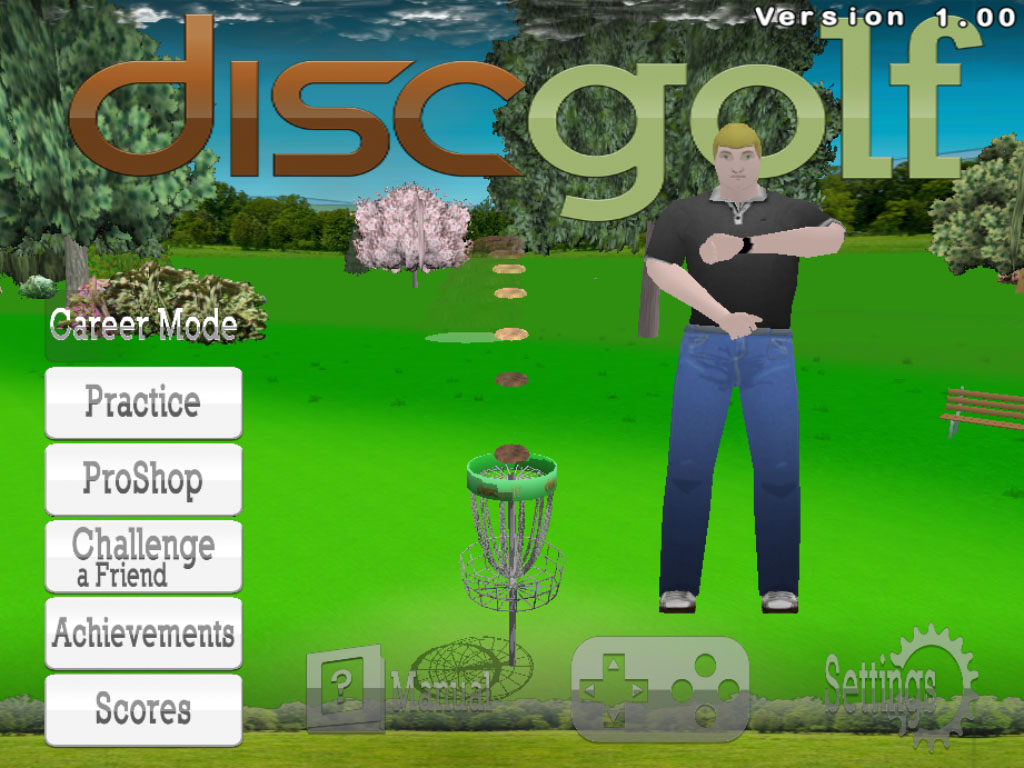
Nuclear Nova's newest game -- Disc Golf 3D.

Nuclear Nova’s newest game — Disc Golf 3D.

Recently released by software company Nuclear Nova, Disc Golf 3D is available for download for Apple platforms and, for this disc golf junkie, was easy to get hooked on.

I had the luxury of enjoying the game on an iPad 2.

I eased into the fray by testing out the game’s practice mode, where I was presented with a selection of discs from which to choose. Using familiar speed-glide-stability ratings, I was able to play with animal-named plastic like Antelope (driver), Manatee (mid-range) and the aptly-named Sloth (putter).

Once on the course, players are treated to a flyover of each hole that serves to show the lay of the land and basket location. While the graphics aren’t flashy, they are serviceable, with trees that shake to emulate wind and varying levels of blue for water. Honestly, though, you won’t be playing this game for how it looks. You’ll be playing for the fun factor.

Continue reading

Three causes for taking extra strokes in disc golf — and how to avoid ’em

By Jack Trageser — Rattling Chains staff

After playing the seventh hole at DeLaveaga the other day, it occurred to me I had already had three bogeys. To loosely paraphrase Ice Cube from back in the 1990’s, I was givin’ out strokes ‘like government cheese!’

Then, in keeping with my longstanding practice of pondering why the bogies occurred rather than simply lamenting the fact, I observed each was attributable to one of the three reasons players take extra strokes in disc golf — bad execution, mental errors, and bad luck.

school of disc golfIf you haven’t thought of your disc golf game from this perspective before, it might be worthwhile to check it out. Bad luck (and good luck!) will happen when it happens, and luck is impossible to control (although often times bad luck is set up by a bad decision). Errors are another thing entirely.

Knowing which type (execution or mental) you’re more prone to commit will help you know which area of your game requires more work in order to improve performance and consistency.

To make it clearer, here are the details of those three bogies at the start of my recent round:

Continue reading

Photo Focus: Jan. 29

(Photo focus will run every two weeks or so on Rattling Chains. The idea is to focus on disc golf photographs submitted by staff members and readers. To see the guidelines for submitting a photograph for this feature, click here.)

P

P

Disc golf is a sport consistently growing to new heights. It’s a sport with a variety of differently styled courses around the globe. And it’s the sport we love so much.

A friend and I decided to take a trip to Sandy Point Resort Disc Golf Ranch in Lac du Flambeau, Wisconsin. It was a four-hour drive to Northern Wisconsin to play a round. My disc golf group and I love traveling around the Midwest, finding new courses on which to challenge one another.

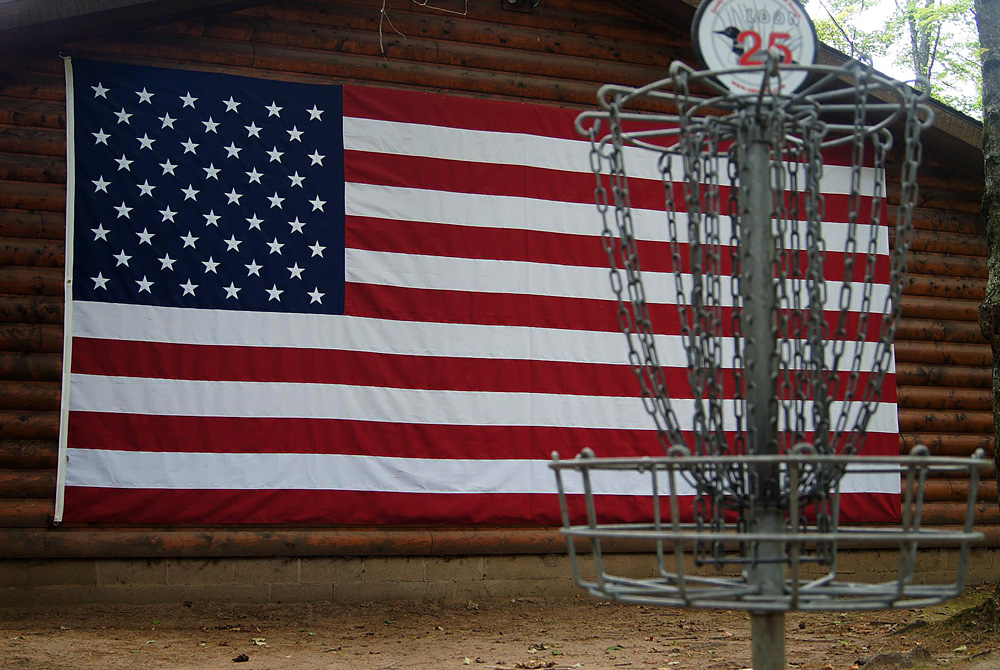
With our first round coming to a close, we stepped up to hole No. 25 with high hopes. A huge American flag was in the background of the basket. There was a pretty wide fairway and the hole measured in at about 250 feet. But with a handful of scattered trees, the drive would be nearly impossible to reach the basket without finding wood.

Originally, this photo was only going to be of the flag. But, I thought to myself, I should draw a connection between disc golf and America. I had to make sure I got the right result and I believe I did just that. With the basket complimenting the flag, I thought this image had a lot of symbolization. It displays a unique expression of patriotism and shows how great this sport truly is.

Techie info:

  • Camera: Sony SLT-A55V
  • Aperture: ƒ/4.5
  • Exposure: 1/50
  • Focal Length: 30 mm
  • ISO: 125

– Kevan Greunke

If you have any comments, questions, thoughts, ideas or anything else, feel free to e-mail me and the crew at: pj@rattlingchains.com. Don’t forget to follow us on Twitter and like us on Facebook!

Poll 44: Building disc golf courses

OK folks, it’s poll time.

The sport of disc golf is something that people look at on different levels. There’s the one-disc player, casual players, kids, tournament players, local pros and top pros.

weekly_pollThere’s probably more there, too.

But the essence of furthering this game goes beyond playing or beyond giving somebody new a disc. The game has to be out there to grow. Though this is a fast-growing sport, there are still a lot of people who have no idea what the game is.

One big thing is the lack of courses in some places.

Despite being able to tell people what the game is all about, or have them throw a disc in an open field or to a portable target, there needs to be more courses. Because as fun as this game is, if you show somebody and they then have to drive an hour or more for a course, the odds are probably more against that person not playing again than going and playing.

All courses have a place. Whether it’s a 9-hole pitch-and-putt to a well-designed 27-hole championship course. Still, they have to be built.

But we’ll touch more upon this below with this week’s question.

First, lets check back to last week’s question when we asked what your favorite type of disc to throw was.

Continue reading

Professor Rizbee’s Disc Golf 101: How to be a better tournament player

By Allen Risley — For Rattling Chains

In my 30-plus years of disc golf experience, I have played in hundreds of organized events, including weekly doubles leagues, course monthlies, PDGA-sanctioned events and world championships. And I’ve organized and run a lot of those, too (except for the world championship. I don’t know if my therapist has enough appointments for me to take that on).

As I’ve been playing and organizing, there are certain truths that have become evident – truths about how to conduct oneself as a tournament player for the best possible outcome for all. Now, this is not a list of how to help you win a tournament – there are enough articles and blog posts out there that purport to be able to do that.

Instead, this is a list of ways that you can enhance your own tournament experience as well as that of those around you. Sure, some of these tips might actually lead to you scoring better and maybe even winning, but the real aim here is to make everyone’s tournament experience more pleasurable, because if we’re not working, we might as well be having fun, right?

Sign up as early as possible. Why do that? Why not wait to see if the field is going to be good, or interesting? Well, what if everyone did that? Would anyone ever sign up? By signing up early, you can be the reason that others jump in – a leader, not a sheep.

Pre-registering for a tournament makes it a ton easier on tournament directors. (photo courtesy Allen Risley)

Pre-registering for a tournament makes it a ton easier on tournament directors. (photo courtesy Allen Risley)

Also, signing up and paying early helps out tournament directors by making money available for them to buy the trophies and player pack items, pay for insurance, or pay park fees. Many TDs burn out after a running a few events, and one reason is that they drive themselves crazy worrying about whether they’re going to lose their shirt because no one is signing up for their event. Help out the TD.

Show up on time. Most events list a start time, whether it be for check-in, the player’s meeting, or for the start of play. Know what those times are and be there on time. It’s even a better idea to be a little early. Why? Show up late for check-in and you might lose your spot in the tournament. You also put the TD in the position of worrying about filling your card, shuffling cards and players, etc. – all the things that raise a TD’s blood pressure and lead to burnout.

Continue reading

Finding go-to discs is never easy

OK, it’s time to get a little personal.

What’s your go-to disc? What disc can you not live without? If you’re playing on a cold winter day and your favorite disc hits a tree and cracks into small pieces, which disc would leave you devastated over your loss? More importantly — what kind of discs are the go-to ones in your bag?

jenny_cookIt all depends on who you ask. But, what’s more interesting is, why?

In the beginning I only knew of a limited number of places to go and purchase discs and, as a female golfer, I didn’t really know what to purchase. So I would try a wide variety and, eventually, the ones that qualified made it to my bag. Then I’d play another amateur tournament, do well, and bring home more plastic. The dilemma would return yet again. Do I make new friends with these discs, but keep the old? Mix them up? Or stash the new ones in my back up bag?

It seems like the brand that made it to my bag first and most often (because of accessibility) was Innova with a peppering of Discraft. I do wish, however, that with all of the friends I made when I first started playing, that one of them would have spoken up about the plastic I was throwing. That’s not to say I couldn’t figure out for myself that, as a new player with slower arm speed and less snap, I shouldn’t be throwing an Orc.

It would have saved me not only from the aggravation of trying to get the disc to fly straight but it also would have saved me from forming bad habits. Such as forcing the disc into an anhyzer in order to compensate for less snap and finally make it land ahead of me on the fairway, instead of it quickly crashing down left into the woods.

Continue reading