Disc golf still looking to go viral

By Jack Trageser — Rattling Chains staff

The day disc golf finally goes viral is . . . not here yet.

Hasn’t happened.

But like a geologist who observes trends and predicts a major earthquake will occur in an area with no seismic history, I believe it will.

Many share my belief, but few agree with my vision of how it will happen and what disc golf’s future potential can be. Those on the inner circle of professional disc golf — and their small but intensely loyal pack of fans — seem to think a major sponsor will come along and bankroll the professional tour, making televised tournaments a reality, thus creating legions of new players and courses.

This is a romanticized vision based more on hopes and dreams than any historical sports precedent, and I feel it is completely backwards.

Corporations are about two things — making money and, if public, increasing share price. They just don’t sink major sponsorship money into anything until they can see that it will draw a measurably significant audience and therefore improve their bottom line. By this yardstick disc golf is no where close.

I asked Rattling Chains founder P.J. to run last week’s poll question, ‘How did you get introduced to the game’ for this precise reason, and the results were just as I predicted — 67 percent said they learned of the sport through a friend, and exactly zero responded that they learned of it through some form of media.

Continue reading

Review: ScoreBand makes scoring a bit easier — once you get the routine down

The ScoreBand is a worth addition to any disc golfers bag.

(Editor’s note: Two people associated with Rattling Chains tested out ScoreBand, a scoring watch that also works for tennis and other things. The first part is by P.J. Harmer).

I’m a stat junkie.

No matter what I do, statistics fascinate me. Whether it’s softball or finds in geocaching or comparing scores on the disc golf course, I really get into it.

One thing with disc golf and me has always been keeping the score. Though there are many phone apps or pencil-and-paper ways of keeping score, I’ve been in search of a quick and easy way of keeping score as I play a round without fumbling with my phone or a pencil.

Insert ScoreBand.

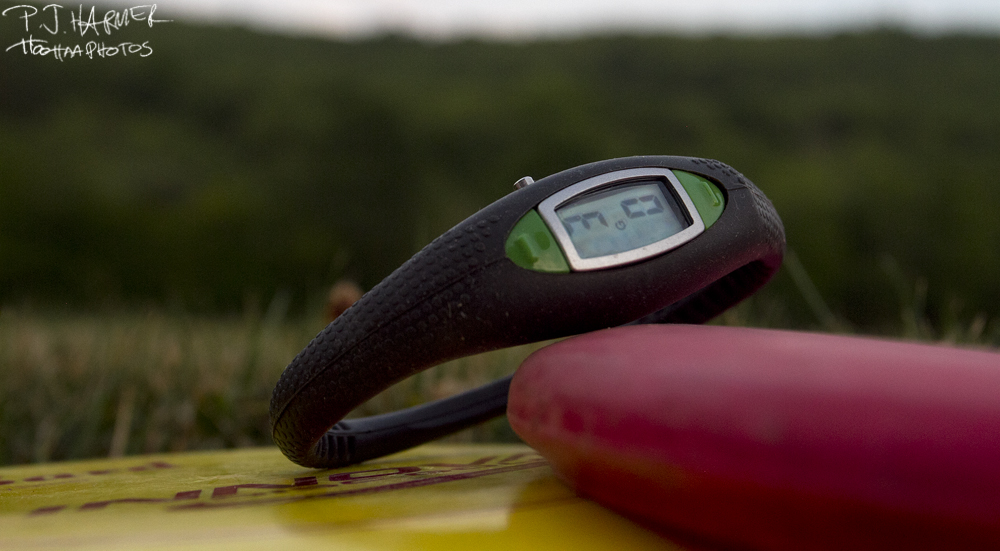
ScoreBand is a rubber wristband/watch. The company calls it a “revolutionary quick-touch, 4-in-1 scorekeeping wristband engineered for sport.” It stood up to the challenge, too.

First, the construction is a one-piece rubber wristband. There are several sizes and colors to choose from, so you’ll be able to find one (or more) that fits your style. It’s comfortable to wear, though I’m not sure I could wear it all the time as I did notice it was there and with the rubber band, it could get a little tough to deal with at times.

Still, this band is easily worn for a round or two of disc golf. I wore it on the opposite wrist of my throwing hand, so I never knew it was there. Also, it made it easy for me to click the score.

I can’t comment on how this would be for ball golf as I always avoided wearing anything on my wrists when playing. I’m sure if people were used to wearing anything when swinging a club, this wouldn’t bother them. The same could be said for tennis.

The ScoreBand has four modes:

  • Golf
  • Tennis
  • All sport
  • Time

Those are four excellent items as it allows you to get multiple uses from one wristband. For golf, it keeps your hole score as well as your cumulative score. For tennis, keep game and set scores.

Though this is something that will be a permanent addition to my disc golf regiment, the all-score mode might be the most intriguing part of this band.

As the company notes on its site, there are many uses for this mode — including some other disc and ball golf functions, such as keeping putts, fairways hit or greens in regulation.

  • Other items that the watch can be used for:
  • Pitch counter for baseball or softball
  • As a head counter where attendance is needed
  • To count inventory
  • Keeping track of how many times you take medication
  • Lap counter

Truthfully, the options are endless with that mode.

Using the band is easy. There’s three buttons — two on the display and one on the side. Once you get the hang of how the watch works, it’s simple to use while playing. The key is remembering to use it.

Though I don’t often do it, perusing the instructions is a smart move and messing with it for a while before taking it out will help you get used to the controls so you can work it while on the course.

ScoreBand is a comfortable band that is easily used throughout a round.

The best part in my eyes?

It keeps your score as you go along. So if you click it after each throw or shot, you can see what you’ve done on each hole. At the end of the hole, add it to your overall score and you’ll have a clean slate for the next hole.

My only issue is it can get a little confusing on how to take your round score and add it to your cumulative score. You have to hold one of the buttons down to have it do this, but in the end, once you get used to it, it shouldn’t be an issue.

Though I love using my phone as a score card, the reality is it can sometimes get cumbersome to take the phone in and out of your pocket, get the screen up and type in scores. In the amount of time that takes, I’m at the next tee or shot with the score already in my watch.

If you are looking for more in-depth stats, the phone apps are probably the best. But if you are out playing and just want a quick and effective way to keep your score, this really is the way to go.

ScoreBand is $29.99, but it’s durable and something all disc golfers should consider having if they want a nice and easy way to keep score during rounds.

Jack Trageser

One thing in particular piqued my interest when asked to review the ScoreBand as a method for tracking disc golf scores and statistics — I wondered if it would work for someone (namely, me) that has made a persistent effort over the past several years to remain ignorant of his cumulative score during a round.

As I’ve discussed before, a primary disc golf philosophy that I espouse centers on playing disc golf in a vacuum. In a nutshell, that refers to being completly immersed with the current shot rather than letting your mind wander about things like past shots and holes, future shots and holes, other games, what’s for lunch, and especially the distraction that pertains to this review . . . total score.

Keeping that in mind, I’ve yet to come across a method for recording my score among the traditional pencil-and-card and smartphone apps. I’ve trained myself to lock each shot on each hole into my memory banks without tallying the total until the round is over.

When I heard how ScoreBand works, however, I thought it might be the first scoring method to allow me to record my score using a device more reliable than my own grey matter — without letting the insidious organ get in its own way.

The design sets it apart from other scoring tools by being something that is worn, rather than carried, taken out and put back away repeatedly. Plus, it has a watch function, too, so you can wear it instead of your normal watch.

ScoreBand’s method of keeping track of the score lends itself to my personal idiosyncrasy as much as its ergonomic design. The user hits one button for each stroke to keep score on the current hole in the upper display, then presses and holds another button to add that hole’s score to the total score in the lower display.

Scoreband is a very cool concept and could help many people with disc golf scoring and many other items.

In theory, this lets a player hit the buttons the required amount of time for strokes and hold it the right duration of time to advance from one hole to another without having to even look at the screens and remain as oblivious as he or she wishes to be where total score is concerned.

In practice, however, I found using the ScoreBand to not be quite so simple (remember, these issues are magnified by my desire to not know my cumulative score during the round).

For starters, there is the issue of when to hit the button to record each stroke. Do you do it right after each throw, or wait until the completion of the hole and hit the button multiple times? In my case, during the five test rounds I played, settling on a system was not easy. In fact, it never happened. I tried to do it throw-by-throw, then would realize on the next tee that I had slacked, requiring me to enter all the strokes on that hole at one time. And it got worse, as a few times I realized I had forgotten for two entire holes.

I guess that can happen with other scoring methods as well, but having to hit a button for each stroke makes it more of an ordeal.

The upper display shows the stroke count for the current hole. When the hole is complete, you press and hold a button and the hole total is added to the round total on the lower display, while the upper one resets to zero. If you forget to record a stroke, or a hole or two, there is no way to tell which hole you last recorded successfully. It’s also an issue for those who want to know how they did hole-to-hole as at the end of the round all you have is total score.

The bottom line is that ScoreBand delivered in the main way I hoped it would. As a stretchy band worn on my non-throwing wrist, it was accessible and out of the way. Once I learned how to use it, I could hit the buttons without looking at the screens, enabling me to avoid knowing my score.

But it either takes time to get the process down to a routine, or I’m just inept at it. Of the five test rounds I played, my total came out wrong twice. I rely on my memory-based compilation after the round is over. Since I can recall each shot in my mind’s eye, it proved my use of the ScoreBand wasn’t perfect. I don’t think the device was faulty — it was a combination of my attention span and the user interface.

In January, ScoreBand was recognized as the Best Product Concept at the Professional Golf Association merchandise show. The people who awarded ScoreBand put more thought into things like that, so if you you’re like me and want a method for scoring that is handy and unobtrusive, ScoreBand may be for you.

If you have any comments, questions, thoughts, ideas or anything else, feel free to e-mail me and the crew at: pj [at] rattlingchains.com. Don’t forget to follow us on Twitter and like us on Facebook!

Using a falling putt can help lower scores

By Jack Trageser — RattlingChains.com Staff

Disc golfers familiar with the rules of the sport recognize the term “falling putt” as an infraction that occurs when the disc is within 10 meters of the target.

The rules (see 803.04 C) clearly state that a player – when inside this putting circle, must demonstrate full balance after releasing the disc before advancing to retrieve his or her disc. This is to ensure players cannot gain an advantage by shortening the distance their disc has to travel.

If this rule were not in place, putting would turn into a Frisbee-long jump hybrid, with players taking 10 paces backward to get a running start before leaping toward the target. I can easily imagine some nasty accidents as well, with “slam dunk” attempts going horribly awry.

Luckily the 10-meter rule prevents gruesome player/basket collisions, while at the same time preserving the purity of the flying disc aspect of disc golf putting.

Of course, when this rule is broken, it is usually much more subtle than that. The player inadvertently leans into the shot and is unable to avoid stepping or stumbling forward. Hence the term “falling” putt. But outside 10 meters no such rule applies, and using your entire body to gain added momentum can be a great strategy. If — and only if — it is done correctly. Plus, even outside of the 10 meter putting circle, it must be done legally.

Continue reading

Be a sponge part 2: Paying attention to detail

By Jack Trageser — RattlingChains.com Staff

The previous post under this heading (To play better disc golf . . . be a sponge!) didn’t focus on the absorbent characteristics of a sponge, but rather the practice of “wringing out” every bit of talent and knowledge one already possesses to maximize performance.

In a nutshell, everyone will make errors in execution at one time or another, and it’s unavoidable. It happens less to better, more consistent players, but it happens. However, mental errors are much more systemic and can usually be avoided or even practically eliminated with the proper mindset.

This post goes back to the absorbent nature of the sponge, with three specific suggestions on how to soak up new information that can help you improve.
  1. Observe and learn from players that are much better than you;
  2. Observe your own game from a detached, analytical viewpoint;
  3. Listen to your body.

Observe and learn from players that are much better than you

The key to this bit of advice is the fact that players is plural. Don’t just pick one player whose game you admire and try to emulate him or her. He or she may have an unconventional style that doesn’t work for most other people (like Nate Doss’ putting technique), or maybe his or her physical capabilities far exceed yours.

Continue reading

To play better disc golf … be a sponge!

By Jack Trageser — RattlingChains.com Staff

I’m speaking to all disc golfers here, but primarily to those of you who really love to play, maybe even 2-3 times a week, but still feel like you could get way better.

The Am2 players who want to move up to Am 1, the Am1 players who want to start challenging the pros, and the rec players eager to see your scores go down.

When you think “Be a Sponge” you probably think I mean something like “Soak up all the advice you can,” or “Watch the top pros whenever you can.”Though neither of those pieces of advice are bad, I’m thinking the opposite sponge metaphor.

The first thing to do when you want to get better disc golf scores is to wring out all the potential you currently have, even as you work to improve and expand your skill set. In any sport, when you hear about an athlete that maximized his or her potential, or overachieved, it’s usually in reference to someone with an average physical game but an extraordinary mental game and strong desire to get better. They squeeze the most out of their physical potential (like wringing out a wet, heavy sponge).

I’m not saying you have to dedicate yourselves to disc golf, a fitness regimen, or anything like that. Just use your head. Figure out ways that you waste strokes during a typical round, and eliminate the waste. Squeeze it out. I address specific ways you can do this in this piece, and in more detail at School of Disc Golf, but you know which areas you need to focus on most. Here are some basics to get you started:

Continue reading

Disc review: Vibram Obex can’t be beat

(Editor’s note: Three people associated with Rattling Chains tested out Vibram’s new mid-range disc, the Obex. Below you’ll find the reviews. All three are different level players, which we hope will allow you to see the differences in the disc via their thoughts. The first part is by Jack Trageser, a pro based in California).

The new Vibram Obex can’t be beat. Believe me, I tried!

Over a couple months’ time I threw it into strong headwinds, threw it with as much power as I could muster, AND threw it with full power and a sharp anhyzer angle. It didn’t buckle and irrevocably turn over one single time. (As a reference point, I don’t have a huge arm, but can still exceed 400 feet with accuracy.)

Vibram’s new mid-range disc is the overstable compliment to the Ibex, which is pretty stable as well, but noticeably less so than the Obex. Steve Dodge of Vibram in fact describes it as a modified Ibex. According to Dodge, Vibram
“took the Ibex and added a Ridge bead to it for stability.”

I like having both because they feel the same in my hand, yet I can tell that the one is a step up from the other in a similar way that a five iron is similar, yet different, from a six iron in ball golf. I guess you could say they compliment each other, which I think is Vibram’s master plan for its eventual complete lineup.

I’m not one to talk in technical terms about a disc — diameter, bead, flight plate, and such. I’m all about feel and performance, and as with all the Vibram discs I’ve tested before, it scores very high in both categories.

Continue reading

Instruction: Building blocks of basic backhand technique

By Jack Trageser — RattlingChains.com Staff

Disc golf is still enough of a niche sport that by the time most of us are ensnared (like a putter caught in the inner chains of a Mach III) by an obsession to get better, we’ve already been heavily exposed to other more mainstream sports.

That reality has definite advantages for me, as an instructor, because it helps when I’m teaching a disc golf concept related to technique (or even mental stuff) to be able to draw analogies between disc golf techniques and those of other more familiar games. If someone has already learned a similar motion, it’s easier to recall that motion and apply it to disc golf than to learn it completely from scratch.

Case in point, my first session with Rattling Chains’ lead blogger P.J. Harmer.

P.J. spoke of the frustration of not being able to throw as far as he wanted or thought he should be able to throw — nor as accurately. Without actually watching him throw live and in person, I had to rely mostly on the spoken and written words we exchanged on the subject in choosing my advice for him. However, I knew a couple other things that would likely prove useful.

First, players in the earlier stages of the disc golf learning curve usually make many of the same common mistakes and therefore see many of the same negative results from those mistakes. Second, P.J. has talked on many occasions of being an avid softball player, so I knew right away that he would be able to easily understand the comparisons I like to use between throwing a disc golf disc using the backhand technique and proper batting technique in baseball.

Weight transfer and balance

Probably the most common mistake I see players of all levels make with the backhand shot has to do with transferring weight from the back foot to the front foot.

Figure 1: The stick in this photo illustrates the line on which players pull back the disc and throw that results in shots that pop in the air and don't go very far.

A good backhand throw derives most of its power from the back, torso, and legs rather than just the arm. In this way (and some others, which we’ll cover soon) throwing a disc backhand is just like swinging a baseball bat with the goal of hitting the ball with any kind of power.

In both cases you’re standing at a 90-degree angle to the direction you want to throw/hit. And in both cases you want your weight to shift from your back foot to your front foot at a precise critical time. With baseball, that time is a fraction of a second before the bat hits the ball. With disc golf, it’s right as the disc is passing your body mid-throw. Any sooner in either case and you’ll rob yourself of all that power you had coiled up from your legs and torso.

Using the baseball analogy, think of what a hitter looks like when he’s way out front on a change-up or curve ball. And in the case of a backhand throw in disc golf, you’ll also likely mess up your balance and lose accuracy as well as distance.

Continue reading

In their words: Nine secrets of the women of disc golf

The ladies who played in the advanced division at the Masters Cup this past weekend. Pictured are: Front -- Anna Caudle. Second row, from left, Victoria McCoy, Michelle Chambless, Lacey Kimbell, Cyndi Baker; and third row, from left, Christine Hernlund, Jenny Umstead, and Crissy White. (Photo by Alex Hegyi).

OK, maybe the title is a little misleading. Calling them “secrets” is overdoing it a bit, and this is about much more than that.

I spent some time last weekend talking to female competitors at the Amateur Masters Cup presented by DGA in Santa Cruz, Calif., and some of their answers might be new and useful information to the guys who play disc golf.

But are they secrets?

What’s definitely not a secret is the fact that disc golf is, and always has been, a sport played predominately by males. The breakdown of competitors in this A-Tier PDGA sanctioned event illustrates this point perfectly, as only 11 of the 158 registered participants were in female divisions. That’s less than 10 percent.

The eyeball test anytime you’re playing a recreational round on your local course will tell you that that ratio holds true in non-tournament settings as well.

So what’s the deal?

After watching the sport grow and develop over the past 25 years, I’ve got my own theories. For instance, in the early days of DeLaveaga — back in the late 1980s and early 1990s — seeing a woman on the course was rare enough to stop a guy mid-throw to ask a playing partner if he saw her, too. They had to make sure she wasn’t a mirage (or an hallucination, depending on the player). I later learned from the first female DeLa pioneers that a main deterrent was the lack of a restroom on site at the time — not even a porta-potty. Not a big deal for the average guy, but enough to keep many women away.

While not all courses are as remote and facility-less as DeLa, back then plenty of them were similarly in open spaces. And besides the lack of basic facilities, there was also an non-policed “Wild West” feel to many courses. I have a notion that many women felt these courses were just unsafe enough — or at least could be — to discourage them from giving disc golf a try.

Continue reading

A friendly reminder: Showing etiquette on the course

In the world of disc golf, many players are unfortunately not even aware of the “etiquette” concept.

I’d guess that many players have had no exposure to ball golf prior to discovering disc golf, and everything about our version of the sport is more casual. Most courses have no pro shops, no marshal, no tee times, and feel much more like what they are: a public park where people can come, go, and do as they please.

However, anyone familiar with ball golf knows that etiquette is a big part of the game. Golf is a self-officiated game, with no referees, umpires or the like to point out when a player has broken a rule or committed an infraction. But “golf etiquette” is specifically concerned with the unwritten rules that have less to do with the scoring part of the game and more to do with respect for the other players in your group and on the course.

According to Merriam-Webster, etiquette is defined as “the
conduct or procedure required by good breeding or prescribed by
authority to be observed in social or official life” In the ball-golf
world, this translates to a universally-understood group of social mores that all serious competitive or even learned recreational players observe.

The more laid-back nature of disc golf means that the rules of etiquette for our sport will differ accordingly. However, the reality that it’s still golf — a game that calls for intense focus to play well, mixed precariously with interactions with groups of people both familiar and unfamiliar — requires us act within unspoken but generally agreed-upon mores.

I personally enjoy a disc golf setting that simulates this aspect of ball golf as closely as possible, and if you’re reading this, odds are that you also treat your rounds of disc golf as more than just tossing plastic for a couple hours. If that is the case, please read my non-exhaustive compilation of disc golf etiquette guidelines and let me know what you think. Tell me if you agree or disagree, and if there is anything I overlooked, which I’m sure is the case.

Continue reading

The number-crunching approach to better disc golf scores

Today’s hopefully useful game improvement post touches on a way you can improve scores on the course by recording and mining the data of past rounds while off the course.

However, talking about crunching numbers tends to get dry in a hurry — especially if you’re reading this in a disc golf frame of mind. So we’ll ease into the meat of this lesson by way of an illustration. The guinea pig in this case is yours truly.

I shot an even-par 84 (28 holes) morning round at DeLaveaga last weekend, and earned satisfaction on two different counts.

First, with the exception of only a few holes, the course is set up in its toughest configuration in preparation of the fast-approaching Masters Cup — an annual stop on the PDGA National Tour. Par in that layout is good for a plus-1000 rated round, and right now, I’ll take that any day of the week and twice on tournament weekends.

Hole No. 1 at DeLaveaga. (Photo by John Hernlund)

The other reason why I was able to bask in my own pysche a little after my round today — and the main subject of this post — is that I had a game plan and executed it quite well. My strategy at DeLa, when the course is long, is to think par at nearly every hole, even off the tee, and even though I can birdie most of the holes with a perfect tee shot and good putt. The result in this case was 24 pars, two birdies, and two bogeys — one of which was on Hole 13, which plays more like a par 4.

So why play for par on a hole when I know I’m capable of doing better? Because being capable of a executing a shot once and being capable of executing it consistently are two very different things. Understanding that basic fact is the first step in properly assessing the risk/reward quotient of every shot in golf — disc or otherwise.

Continue reading